
Urban density
A view from above of high-rise clusters, showing the concentration of workplaces and residential space
Shenzhen: A City in Focus · 2026
Coastlines, mountains, ancient towns and new districts. People arrive from across the country and beyond to work, live and create, continually reshaping the city.

01 / A Portrait of the City
Shenzhen is more than a city of skyscrapers, businesses and growth rates. It is also the story of decades of institutional experimentation, a stretch of the Lingnan coast with a long history, and a place where millions of ordinary people make their lives.
Understanding Shenzhen through geography.The city lies on the eastern bank of the Pearl River Estuary. Hong Kong borders it to the south; to the west are the estuary and Lingdingyang waters, while the east reaches Dapeng Bay and its peninsular coastline. Dongguan and Huizhou lie to the north. Border crossings and ports make Shenzhen an important link between mainland China and Hong Kong, and between the Pearl River Delta and international markets. Mountains, valleys and coastline also constrain developable land, shaping the city's east–west urban pattern.
Understanding Shenzhen through time.Modern Shenzhen was approved as a city in 1979, and the Shenzhen Special Economic Zone was established on August 26, 1980. The two dates mark different milestones: municipal administration and a reform-and-opening-up policy experiment. On July 1, 2010, the Special Economic Zone was expanded to cover the entire city. Nantou Ancient City, Dapeng Fortress, villages and coastal trade all remind us that the history of this place long predates modern city status.
Understanding Shenzhen through industry.Manufacturing, electronics and information technology, scientific research, finance and modern services together sustain Shenzhen's economy. According to the Shenzhen Statistics Bureau's 2025 statistical communiqué, the city's GDP was RMB 3.87318 trillion (38,731.80 hundred million yuan). Secondary industry accounted for 37.4% of value added and tertiary industry for 62.5%. Shenzhen's economy is not just the internet and software: it also depends on factories, logistics, supply chains and a vast range of service jobs.
Understanding Shenzhen through its people.At the end of 2025, Shenzhen had 18.2485 million permanent residents (1,824.85 ten-thousand people). Migrants from different provinces and longstanding local communities together make up the city. Mandarin is widely spoken, while Cantonese, Hakka and other dialects coexist in neighborhoods, households and public life. Diversity is reflected not only in talent and businesses but also in commuting, families, schools, markets and community networks.
Understanding Shenzhen through everyday life.Alongside dense employment hubs and constantly changing industrial spaces are practical challenges: housing costs, long cross-district commutes, public education, eldercare and urban renewal. Shenzhen has innovation resources, but also mangroves, mountains and bays. How it can improve job opportunities and quality of life together is an essential question for anyone trying to understand the city.
Shenzhen cannot be understood from a single year's GDP ranking.History explains where it came from; institutions explain why it has changed; mountains and sea define its physical limits; and residents and public services reveal what life in the city is actually like.
Sources:Shenzhen Archives, 'History of Shenzhen's Administrative Establishment';Shenzhen Statistics Bureau, '2025 Statistical Communiqué on National Economic and Social Development'. The citywide GDP above is based on unified city-level accounting. District charts on this page use data released by each district and the corresponding reporting periods. Figures must not simply be added together or compared across periods without checking their coverage and statistical definitions.
From above, Shenzhen appears as an urban corridor of mountains, bays, roads and high-rise buildings. In industrial statistics, it is an economic network linking factories, software companies, ports and research laboratories. From a resident's perspective, it is also rental contracts, school pickups, late-night commutes and weekend walks. All three perspectives complement one another, and none is enough to explain the entire city. Economic growth alone overlooks communities, while travel photographs alone can miss the institutions and labor behind the urban landscape.
Shenzhen was established as a city in 1979 and its Special Economic Zone in 1980. These institutional turning points help explain the mechanisms of its rapid modern growth, but they do not erase the coastal villages, defensive forts and county life that came before. Walking from Nantou Ancient City to the business districts along Shenzhen Bay, several layers of urban history can appear within a relatively short distance: old-town lanes, urban villages, former industrial sites and new office towers may be close together yet tell very different economic and social stories.
According to the Shenzhen Statistics Bureau, GDP for 2025 was RMB 3.87318 trillion (38,731.80 hundred million yuan), while cumulative GDP for the first three quarters of 2026 was RMB 3.025085 trillion (30,250.85 hundred million yuan). These are annual and January–September cumulative figures, respectively. Simple subtraction cannot establish year-on-year performance, nor can district-level figures with different coverage be added directly to reconstruct the citywide total. The larger an economy becomes, the more important it is to understand its sources of growth: manufacturing output, service transactions, household spending and demand from external markets represent different kinds of activity.
Population tells another side of the story. Shenzhen had 18.2485 million permanent residents (1,824.85 ten-thousand people) at the end of 2025. This is an end-of-year statistical count, not a daily measure of everyone physically in the city, and it certainly does not imply that everyone lives in newly built towers. Understanding Shenzhen means considering both the total and its distribution: the streets where people live, where public services are provided, and how employment centers shape commuting offer a more realistic picture than any single number.
To observe Shenzhen, divide a visit into three stages: first, see how the city meets nature at the shoreline; next, visit older districts to explore their administrative history and everyday life; finally, explore technology parks and areas around factories to understand today's industries. At each stage, pay attention to the street-level experience: are roads easy to cross, are public spaces welcoming places to stop, and do both longstanding residents and newcomers share in the city's transformation? This approach reveals more than the abstract labels 'young,' 'innovative' and 'fast.'
A view from above of high-rise clusters, showing the concentration of workplaces and residential space

Modern buildings and the Greater Bay Area skyline

Sunset and residents along a waterfront in a Shenzhen park
These images are real photographs of Shenzhen published by their photographers, with links to the original works. They visually complement the topics discussed but are not substitutes for statistical or historical evidence. Data are drawn from the official annual statistical communiqués and quarterly releases cited in the article; a consolidated source list appears at the end.
02 / History & Opening Up
Municipal establishment in 1979 and the creation of the Special Economic Zone in 1980 marked pivotal changes in modern Shenzhen, but they were not the beginning of human settlement, local administration or cross-sea exchange in this region.
Prehistoric coastal settlements.The Xiantouling archaeological site in Xiasha Community, Dapeng New District, stands on a coastal sand ridge beside Dapeng Bay. Archaeological findings trace it to the Neolithic period about 7,000 years ago. Painted pottery, white pottery and stone tools provide material evidence of daily life among the early coastal inhabitants of the Pearl River Delta. They show that people lived and worked along this shore long before the rise of the modern metropolis. 'Seven thousand years' refers to the cultural age of the archaeological finds; it must not be misconstrued as saying that Shenzhen itself was founded 7,000 years ago.
331: Bao'an County and Nantou.In the sixth year of the Eastern Jin dynasty's Xianhe era (331), Dongguan Commandery was established, governing six counties including Bao'an. Both the commandery seat and the Bao'an county seat lay around present-day Nantou in Nanshan. This was an important early county-level administrative establishment in the Shenzhen area. County names and boundaries changed many times thereafter, so Eastern Jin Bao'an County should not be equated directly with today's Bao'an District or Shenzhen Municipality. Nantou's surviving streets and historic sites matter precisely because the area once served as a center of regional administration, trade and transport.
1394: The emergence of fortified coastal towns.In the 27th year of the Ming dynasty's Hongwu era (1394), coastal-defense garrisons including the Dongguan and Dapeng thousand-household military posts were established. Their fortified settlements correspond to historical sites such as today's Nantou Ancient City and Dapeng Fortress. They were intended to defend the coast, shipping routes and coastal residents, reflecting the realities of maritime transport and security along the Lingnan shoreline. What visitors see in these ancient towns today is the result of construction, alteration and continuous habitation over multiple periods, not a landscape built all at once in a single year.
1573: The establishment of Xin'an County.In the first year of the Ming dynasty's Wanli era (1573), Xin'an County was created from parts of Dongguan County, with its administrative seat at Nantou. Its historical territory included portions of what are now Shenzhen and Hong Kong. During the Qing dynasty, coastal evacuation policies temporarily affected the county's administration and local livelihoods before it was re-established. Historic county boundaries differ from modern municipal and Special Administrative Region boundaries, so any discussion of area or population must specify the relevant historical period.
Changing ties between Shenzhen and Hong Kong in the modern era.During the mid-to-late 19th century, Hong Kong Island, Kowloon and the New Territories successively came under British colonial administration through a series of unequal treaties. Communities that had previously been connected found themselves divided by new administrative and customs boundaries. Movement, trade, kinship and linguistic ties nevertheless persisted. Today's relationship between Shenzhen and Hong Kong is shaped both by that modern history and by new forms of cooperation and border governance following Hong Kong's return to Chinese sovereignty in 1997. Neither 'Shenzhen developed Hong Kong' nor 'Hong Kong created Shenzhen' adequately captures the complexity of their ties.
1914–1953: Changes in place names and the county seat.In 1914, Xin'an County was renamed Bao'an County because it shared a name with a county in Henan Province. In 1953, the county seat moved from Nantou to Shenzhen Town. This shows that 'Shenzhen' was already a place name used in local transport, commerce and administration before the modern city was established. Historical names such as Shenzhen Market and Shenzhen Town have a connection with Shenzhen Municipality after 1979, but they refer to different administrative levels and territorial extents.
Becoming a city in 1979 was not the same as becoming a Special Economic Zone in 1980.On March 5, 1979, the State Council approved the conversion of Bao'an County into Shenzhen Municipality. Archival records suggest that the choice of 'Shenzhen' as the city's name was related to the recognition of Shenzhen's border crossing in external trade and travel. On August 26, 1980, the Standing Committee of the National People's Congress approved the Regulations on Special Economic Zones in Guangdong Province, formally establishing the Shenzhen Special Economic Zone. The former was an administrative change; the latter was an institutional arrangement for reform and opening up. They should be recorded separately. Industry, ports, manufacturing, housing and transport infrastructure subsequently drove rapid expansion, while new forms of public life gradually took shape in this migrant city.
1993–2010: From county territory to a citywide Special Economic Zone.In 1993, the former Bao'an County was abolished and two municipal districts, Bao'an and Longgang, were established. On July 1, 2010, the Special Economic Zone was extended to the entire municipality, changing the administrative boundary long referred to in everyday speech as the divide between 'inside' and 'outside' the Zone. Enlarging the Zone did not mean that differences in terrain, regional development and public services disappeared overnight.
How to read that history today.Nantou Ancient City, Dapeng Fortress, Hakka enclosed houses, old villages, early industrial buildings and public facilities dating from the reform-and-opening-up period preserve traces of different communities and eras. Protecting historic buildings requires documenting their dates, functions and transformations, while also considering the relationship between longtime residents, community memories and contemporary urban renewal. In Shenzhen, 'new' and 'old' do not replace one another: they are different layers of the same city.
Neolithic sites along Dapeng Bay have yielded pottery and stone tools, recording the activities of early coastal communities.
The Eastern Jin dynasty established Dongguan Commandery, with the Bao'an county seat near today's Nantou; the ancient territory differed from modern administrative boundaries.
Ming-era coastal military defenses became important surviving landmarks in Shenzhen's maritime defense history.
In the Ming dynasty, Xin'an County was carved out of Dongguan County, with its seat at Nantou. It was later briefly abolished and restored.
The old name Bao'an County was reinstated because the county shared the name Xin'an with one in Henan Province.
Bao'an County's administrative center moved from Nantou to Shenzhen Town, gradually shifting the local urban center.
On March 5, the State Council approved the new municipality; its name reflected the prominence of the Shenzhen border crossing.
On August 26, the Regulations on Special Economic Zones in Guangdong Province were approved, beginning a new phase of institutional experimentation.
Bao'an County was abolished and two municipal districts, Bao'an and Longgang, were established.
From July 1, the Zone was extended across the municipality, altering the former 'inside' and 'outside' administrative divide.
The central government supported Shenzhen in building a pilot demonstration area of socialism with Chinese characteristics, ushering in a new stage of reform and experimentation.
Historical sources and definitions:Dapeng New District · Xiantouling Archaeological Site;Shenzhen Yearbook 2025: Administrative History;Shenzhen Archives · From Bao'an County to Shenzhen Municipality;Shenzhen Archives · Changes in Bao'an County's administration;Shenzhen Archives · History of administrative divisions;Shenzhen Government Online · Policy guide to protecting historic neighborhoods. The dates listed refer to different kinds of evidence or events—archaeological cultures, administrative systems, military installations and policy changes—and should not all be treated as equivalent dates for the city's founding.
The Xiantouling site offers archaeological clues to early coastal culture on the eastern shore of the Pearl River Estuary, while Nantou became a regional administrative center under later commandery and county systems. The prehistoric archaeological date, the establishment of Eastern Jin administrative units and today's Shenzhen Municipality refer to different historical subjects. A common mistake in city histories is to project modern administrative names backward: people living 7,000 years ago did not inhabit a 'Shenzhen Municipality' in the modern sense, and ancient Bao'an County was not the same as today's Bao'an District.
In antiquity, Shenzhen's coastline was closely connected with fishing, commerce, maritime defense and the movement of village communities. Fortifications such as Dapeng Fortress responded to threats at sea and also created places where soldiers and residents lived side by side. Understanding these fortified towns requires more than knowing when they were built; it also means examining centuries of subsequent alterations, livelihoods and community relationships.
Nantou Ancient City's renewed visibility owes much to both historic-building conservation and the development of cultural commerce and urban regeneration. Revitalization can introduce public activities, exhibitions and spending, but it may also bring changing rents, altered lifestyles for longtime residents and the overcommercialization of historical interpretation. Renewal is not simply about turning 'old buildings into new attractions'; it requires a continuing balance among the authenticity of heritage, openness of streets, everyday life and commercial activity.
When exploring an ancient town, distinguish four kinds of material: excavated artifacts, architectural remains from successive periods, streets and lanes still in use, and newly built exhibition or retail facilities. They may stand next to one another, but their evidentiary value is entirely different. A photograph of traditional tiled eaves that looks old is not enough to establish that the building dates from the Ming dynasty.
Photographs in a history chapter should answer specific questions: what survives of Nantou's gates, which street patterns remain in Dapeng Fortress, how traditional religious spaces are still used, and how commercial renewal has changed ancient towns. The licensed photographs in this group show traditional buildings and cultural landscapes in present-day Shenzhen, not direct archaeological images of Nantou Ancient City or Dapeng Fortress. They offer visual comparisons but cannot establish the age of those sites. For specific monuments, consult official heritage documentation and records from the sites themselves.
Understanding Shenzhen's role in China's integration into the world economy requires connectinginstitutional opening, factory production, international trade, technological learning and the overseas expansion of businessesinto one account. Shenzhen did not invent China's global trade from nothing, nor can it be reduced to a port or a handful of famous companies. Its development reflects national reform-and-opening-up decisions, the geographic advantages of Guangdong and Hong Kong, local experimentation, cooperation across China's manufacturing regions and sustained interaction with international markets.
1978–1979: The policy starting point and the Shekou experiment.The Third Plenary Session of the 11th Central Committee of the Communist Party of China in December 1978 opened a new phase of reform and opening up. In 1979, China Merchants Group began port development and investment promotion in the Shekou Industrial Zone. Experiments in open recruitment, competitive bidding and employee remuneration addressed practical questions about construction funding, managerial efficiency and how businesses should operate in response to actual demand. Shekou did not suddenly emerge after the Special Economic Zone was created in 1980, nor was it the sole origin of Shenzhen's manufacturing system.
1980: The Special Economic Zone was not simply 'approval for a few factories.'After the Regulations on Special Economic Zones in Guangdong Province were approved on August 26, 1980, Shenzhen explored new practices in land development, foreign investment, labor management, construction, pricing and business operations, differing from established central-planning methods. Early inflows of capital, technology, equipment and management expertise helped create export-processing capacity, while also forcing businesses to meet quality standards, delivery deadlines and the demands of overseas orders.
1984: Renewed recognition of the reform experiment.Following Deng Xiaoping's visit to Shenzhen in 1984, development of the Special Economic Zone continued. The significance of reform cannot be captured by a single photograph of his visit; it was also reflected in concrete institutional practices taking shape, including competitive procurement, business competition, financing arrangements and recruitment.
Late 1980s–1990s: Expanding business operations and financial services.Export-oriented manufacturing in electronics, textiles and other sectors created substantial employment in early Shenzhen. As market reforms deepened and technical capabilities accumulated, telecommunications equipment, electronic components and software businesses developed. Hong Kong's trade channels, financing services and international networks, together with Shenzhen's and the Pearl River Delta's engineering and production capabilities, formed connected but distinct areas of specialization. Cross-border cooperation was never a single fixed formula of 'Shenzhen makes it, Hong Kong sells it.'
1992: The direction of reform and expectations of opening up.Deng Xiaoping's return visit to Shenzhen took place amid a major national debate over the direction of economic reform. Market-oriented reform and the development of business institutions subsequently continued to deepen. Not every instance of a city's growth can be attributed to a single speech, nor should concurrent nationwide policy changes be overlooked.
December 11, 2001: China formally joined the World Trade Organization.This was a milestone in China's nationwide opening up, not a case of Shenzhen independently 'joining the WTO.' National changes involving tariffs, market access, trade rules and intellectual property systems combined with Shenzhen's existing export-manufacturing base to deepen local companies' participation in cross-border sourcing, international orders, quality standards and global industrial specialization. Larger markets created opportunities, but also intensified international competition, trade frictions and pressure to upgrade industries.
From contract manufacturing to research and brands.Processing trade did not vanish overnight in any particular year. Shenzhen-based businesses have steadily expanded their own research and development, product design, technical services and overseas sales, while continuing to rely on chips, materials, software, equipment, suppliers and customers across China and the world. A headquarters in Shenzhen does not mean that every component comes from Shenzhen. Goods declared for export through a Shenzhen port do not imply that all the associated value added remains in the city.
2010 and 2021: A new round of institutional experimentation in Qianhai.In 2010, the State Council approved an overall development plan for the Qianhai Shenzhen–Hong Kong Modern Service Industry Cooperation Zone. In 2021, a further reform-and-opening-up plan expanded the cooperation zone from 14.92 to 120.56 square kilometers. Whereas early Shekou experimentation emphasized industrial zones and enterprise operations, Qianhai has focused more on modern services, finance, legal services, cross-border regulations and Shenzhen–Hong Kong cooperation. Expanding an area's designated size is a policy and spatial change, not an economic achievement in itself.
Using 2025 data to assess Shenzhen's 'global connections.'Shenzhen's total trade in goods for the year wasRMB 4.553389 trillion (45,533.89 hundred million yuan)of which exports wereRMB 2.738781 trillion (27,387.81 hundred million yuan)and imports wereRMB 1.814608 trillion (18,146.08 hundred million yuan); exports of high-tech products reachedRMB 1.276595 trillion (12,765.95 hundred million yuan)accounting for46.6%. Total exports fell 2.6% year on year, while imports grew 8.0% and high-tech product exports rose 10.1%. Different categories moved in different directions, so one cannot infer that 'all export-oriented businesses are expanding' merely from aggregate trade growth. In 2025, Shenzhen ranked first among large and medium-sized mainland Chinese cities for exports for the 33rd consecutive year, using the city export measure in the statistical communiqué.
Foreign investment, international orders, trading intermediaries, finance, shipping and professional services forged close cooperation between Hong Kong and Shenzhen in the early period. The two cities operate under different legal and customs regimes, so movements of people, goods and capital require specific rules to connect them. Today, Shenzhen–Hong Kong ties also encompass university research, innovation, entrepreneurship and modern services—not just travel through border crossings.
Research and development in Nanshan, electronic component trading in Huaqiangbei, manufacturing support in Bao'an and Longgang, seaborne trade through Yantian and Nanshan port areas, high-value air freight via the airport, and production capacity in neighboring Dongguan and Huizhou work together to meet market demand. This is an illustration of a collaborative network, not a claim that every product passes through every stage or that the economic output of neighboring cities belongs to Shenzhen.
Historical sources for this section:Shenzhen Government Online · History of Special Economic Zone reforms;Ministry of Foreign Affairs · China and the WTO;Shenzhen Government Online · Qianhai Master Plan;Shenzhen Statistical Communiqué 2025. This account of historical mechanisms is a synthesis and should not attribute all the achievements of nationwide institutional reform to Shenzhen.
Shenzhen's opening up is not just a label for a particular era. The industrialization experiments in Shekou, construction of the Special Economic Zone in 1980, movement of people through Shenzhen–Hong Kong border crossings, and development of the Qianhai Shenzhen–Hong Kong Modern Service Industry Cooperation Zone represent different periods of institutional and economic practice. Opening up gradually came to include manufacturing, services, capital, professional talent and regulatory coordination, while also exposing the city to more fluctuations in international markets.
In 2025, 15,906 new foreign direct investment enterprises were established across the city, and actual utilized foreign direct investment reached RMB 50.484 billion (504.84 hundred million yuan).The number of newly established enterprises is not the same as investment value, and foreign trade volume is not GDP.To understand opening up, consider the business environment, international cooperation, social mobility and whether ordinary people are able to share in new opportunities.

Detail of an incense burner at a traditional Shenzhen temple; this is not an artifact from Nantou Ancient City

An actual view of Huaxing Temple in Shenzhen, illustrating the city's folk and religious spaces; not a historic structure at Dapeng Fortress

Inscribed decoration on traditional architecture in Shenzhen; not evidence of the date of a particular historic town
These images are real photographs of Shenzhen published by their photographers, with links to the original works. They visually complement the topics discussed but are not substitutes for statistical or historical evidence. Data are drawn from the official annual statistical communiqués and quarterly releases cited in the article; a consolidated source list appears at the end.
03 / Mountains, Sea & Geography

Shenzhen did not spread across a vast, flat plain. With hills and mountains behind it and the Pearl River Estuary and South China Sea ahead, its relatively narrow land area accommodates an interwoven landscape of urban districts, ports, industrial corridors, rivers and ecological spaces.
Long from east to west, connected from north to south.Shenzhen lies in southern Guangdong on the eastern bank of the Pearl River Estuary. It borders Dongguan and Huizhou to the north and is connected to Hong Kong across the Shenzhen River and adjacent bays to the south. Daya Bay and Dapeng Bay lie to the east, while Lingdingyang and the Pearl River Estuary lie to the west. According to the municipal government's geographical overview published in 2025, the city covers approximately 1,997.47 square kilometers; its land area is not an unlimited blank canvas for expansion.
From mountains to plains.Across the municipality, elevations are generally higher in the southeast and lower in the northwest, with mountains, hills, terraces and plains interlocking. Wutong Mountain and the ranges extending westward form a prominent topographic backbone. Valleys and passes among the hills create corridors for roads, homes and industrial parks. Coastal plains and relatively level areas accommodate denser development, while the close meeting of mountains and sea in eastern Shenzhen makes the boundary between construction and nature protection more evident.
One city, two kinds of coastline.Western Shenzhen faces the Pearl River Estuary and Lingdingyang, with a concentration of ports, transport links and industrial facilities. To the east lie Dapeng Bay, Daya Bay and the Dapeng Peninsula, where mountains meet sheltered coves, sandy beaches and rocky shores. A government shoreline survey released in 2018 recorded 260.5 kilometers of coastline: 160.1 kilometers of artificial shoreline and 100.4 kilometers of natural shoreline. Coastline lengths can change with survey methods and planning definitions, so figures from different years should not be mixed indiscriminately.
Rivers shape boundaries and urban corridors.Not all Shenzhen's rivers flow into the same sea. The water authority identifies five major river basins: the Shenzhen, Maozhou, Guanlan, Longgang and Pingshan rivers, linked to water systems including the Pearl River Estuary, Shenzhen Bay, Dapeng Bay and Daya Bay. The Maozhou River passes through industrial and urban areas in the northwest, while the Shenzhen River flows near Luohu and Futian into Shenzhen Bay. The Guanlan, Longgang and Pingshan rivers also connect watersheds across municipal boundaries. Rivers must be managed for drainage and water supply, but their banks are also important spaces for greenways, urban parks and ecological restoration.
Shenzhen–Hong Kong relations extend beyond a line on a map.The Shenzhen River forms an important historical and geographical boundary between Shenzhen and Hong Kong. Border crossings, railways and roads continually connect the movement of people, goods and commercial activities. Ecological challenges in rivers and bays do not stop at administrative lines: wastewater treatment, flood control and wetland protection must be approached at the scale of entire river basins and coastlines.
Climate shapes the way the city works.Situated south of the Tropic of Cancer, Shenzhen has a subtropical monsoon climate, with long summers and short winters. The Shenzhen Meteorological Bureau's climate overview, updated in 2026, gives an average annual temperature of approximately 23.3°C and annual precipitation of about 1,932.9 millimeters over the long term. Around 86% of rainfall occurs during the April–September flood season. These are climate averages, not observations from a single year. Intense short-duration rain, typhoons, storm surges and high temperatures make drainage, flood control, building safety and coastal ecological restoration enduring priorities.
How geography changes everyday life.Within Shenzhen, the western industrial areas of Bao'an, the established centers of Futian and Luohu, Nanshan's waterfront technology districts, Yantian's mountainous port area and Dapeng's peninsula settlements have different development densities, transport conditions and rhythms of life. Understanding differences between east and west means examining terrain, rivers, rail transit, employment distribution and ecological conservation together, not simply dividing the city into 'center' and 'periphery.'
Official sources:Shenzhen Government Online · Geography (2025);Shenzhen's Master Plan for Building a Park City;2018 Coastal Shoreline Resurvey;Shenzhen Water Authority · Five River Basins and Four Major Water Systems;Shenzhen Meteorological Bureau · Climate Overview (2026)。
On the eastern Dapeng Peninsula, mountains approach the sea, and beaches, rocky shores, coves and forests can occur within short distances. Coastal places such as Dongchong and Xichong reveal the coastline's natural contours, but limits on beach capacity, coastal erosion, marine litter and traffic congestion are reminders that tourism and ecological protection do not automatically align. The same beach can look very different depending on the season and tide.
Shenzhen Bay on the western side offers another type of shore, where built-up districts, cross-border connections, wetlands and long public walking routes converge. Waterfront greenways and leisure facilities make sea views accessible to residents, but they must also protect bird habitats, intertidal ecosystems and flood safety. The Shenzhen Bay Bridge provides a cross-border link, while coastal mangroves show that the bay is not only transport infrastructure but also a living ecosystem.
The Shenzhen, Maozhou, Guanlan, Longgang and Pingshan rivers belong to different watershed systems. In a city shaped by rapid industrial expansion, waterways affect not only drinking-water sources, drainage and flood control but also industrial park locations and redevelopment along their banks. Newly built riverside greenways can improve everyday experience, yet their effectiveness requires long-term evaluation of water quality, flood risks, riparian ecology and neighborhood access.
Mountains impose another kind of limit. Wutong Mountain and forests in the east create scenery while supporting biodiversity and water conservation. Because construction cannot expand indefinitely, existing built-up areas must distribute land for homes, industry, transport and parks more carefully. A 'high-density city' is not simply one with more tall buildings; it requires more refined public services, walkable spaces and disaster management.
A subtropical monsoon climate brings a long, hot and humid season. Heavy short-lived rainfall and typhoons during the flood season can disrupt walking, rail connections, coastal facilities and building safety. Shade, rain shelters, ventilation and accessible places of refuge may appear to be small street-level details, but they determine whether a city remains comfortable to use in hot weather. Climate adaptation involves more than large water-engineering projects; it includes the streets residents use every day.

Where bays, beaches and mountains meet on the Dapeng Peninsula

Rocky shorelines, waves and visitors along the Shenzhen coast

These images are real photographs of Shenzhen published by their photographers, with links to the original works. They visually complement the topics discussed but are not substitutes for statistical or historical evidence. Data are drawn from the official annual statistical communiqués and quarterly releases cited in the article; a consolidated source list appears at the end.
04 / Portraits of Ten Districts
Shenzhen has nine municipal administrative districts and the separately administered Dapeng New District. Differences among areas are about more than GDP rankings: they also arise from coastal and mountain geography, industrial specializations, transport networks, historic settlements and population patterns.
This section looks at each district from three perspectives: spatial location, industry and history, and everyday life. Interactive charts below provide 2025 district-level GDP, population and area figures, along with verified economic data for the first three quarters of 2026. Dapeng New District has a different administrative status from the nine municipal districts, and the Shenzhen–Shanwei Special Cooperation Zone is listed separately. These ten areas should not be mistaken for ten identical administrative units.
Based on the2024 Standard Map of Shenzhen (Municipal Administrative Divisions)published by Shenzhen's Planning and Natural Resources Bureau, with Futian, Luohu, Nanshan, Bao'an, Longgang, Yantian, Longhua, Pingshan and Guangming marked in distinct colors, along with Dapeng New District.Dapeng New District is a specially administered new district, not a tenth municipal administrative district.For the latest district boundaries, consult the official standard-map service.
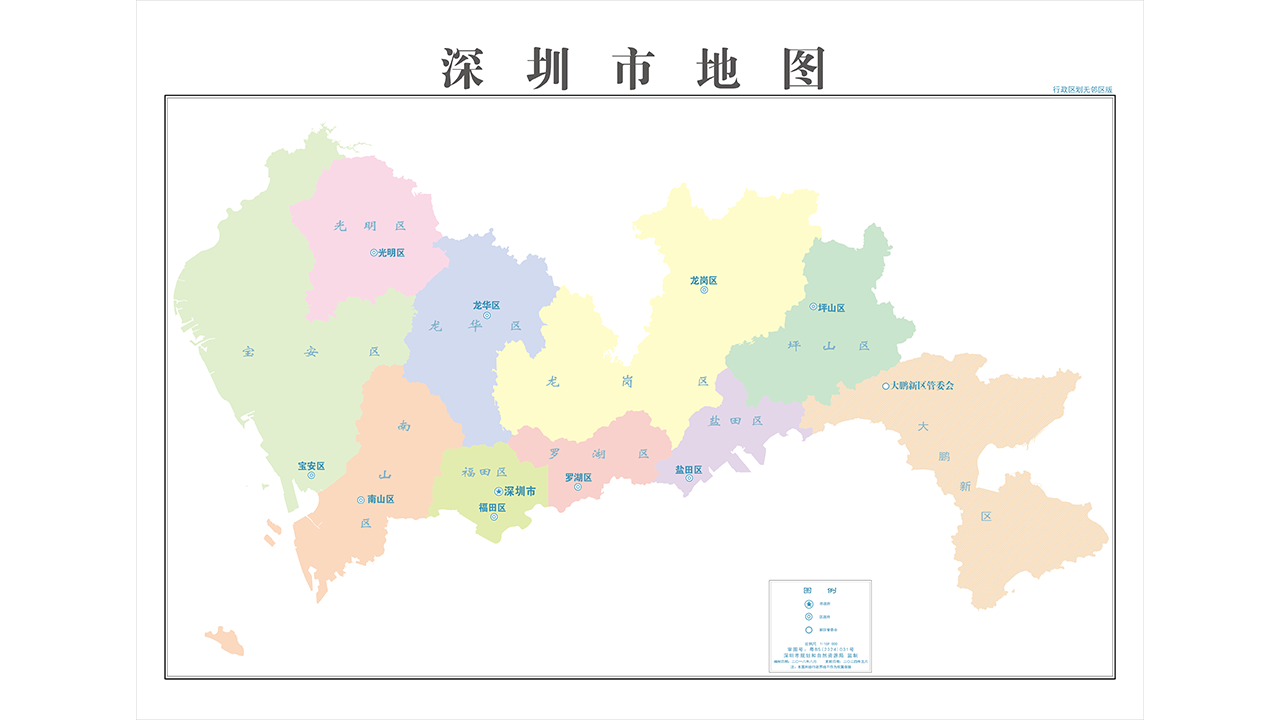
Located in central Shenzhen, Futian is a major core district concentrating municipal government agencies, financial institutions and business offices. The convention and exhibition area, Shopping Park and the Hetao Shenzhen–Hong Kong Science and Technology Innovation Cooperation Zone serve different urban functions, while Huaqiangbei maintains its longstanding role in electronics markets and industrial services. Futian has well-established residential areas, but redevelopment, school capacity and peak-hour transport demand remain pressing concerns.
Luohu is one of Shenzhen's earliest urbanized districts. Luohu Port, Shenzhen Railway Station, the Dongmen pedestrian shopping area and the Shuibei jewelry cluster reflect successive stages of its commercial development. Established housing and street networks coexist with mature public facilities and redevelopment of older neighborhoods. The southern slopes of Wutong Mountain and Shenzhen Reservoir also create prominent ecological boundaries.
Nanshan brings together technology parks, Shenzhen University, the Shenzhen Bay Super Headquarters Base, Qianhai and Shekou. Its varied areas include corporate R&D headquarters, university research institutions, ports, waterfront housing and creative cultural spaces. District-level GDP exceeded RMB 1 trillion in 2025, but economic output must be considered separately from housing costs and cross-district commuting challenges.
Bao'an includes Shenzhen Bao'an International Airport as well as established industrial and residential areas in Fuyong and Shajing. Advanced manufacturing, electronics supply chains and western transport and logistics networks are closely connected. As the western coastal industrial corridor and urban renewal advance, its large population and mix of industrial parks, urban villages and new housing show why public services cannot be planned solely around the needs of central business districts.
Longgang stretches across northeastern Shenzhen, with marked differences among Bantian, Buji, Henggang, Longcheng and Pingdi. Bantian hosts electronics and information-technology businesses, while central Longgang provides district-level public services. Hehu New Residence preserves a strand of Hakka history. The broad distribution of homes and jobs makes rail transit, interdistrict commuting and school provision particularly important.
Minzhi, Longhua, Dalang and Guanlan, including the area around Shenzhen North Railway Station, form a northern transport and industrial corridor. Advanced manufacturing bases sit alongside densely populated neighborhoods and emerging commercial centers. Migration, industrial upgrading and the balance between homes and workplaces shape local experiences of road transport, education and public recreation.
Yantian Port handles major container shipping and logistics functions, while Dameisha, Xiaomeisha and the surroundings of Wutong Mountain are known for coastal recreation and natural landscapes. With mountains close to the shore, space for construction is relatively limited. Transport access, seasonal tourism demand, relations between the port and its host city, and ecological protection must all be coordinated.
Pingshan focuses on manufacturing and R&D in new energy vehicles, biomedicine and related fields. Industrial parks and construction of a new urban center are changing the district. As a relatively recently established administrative district, extending rail transit, expanding education and healthcare, and connecting older villages with new neighborhoods directly affect its long-term appeal as a place to live.
Guangming Science City is developing major research facilities, institutes and new industrial spaces. Gongming, Guangming and Fenghuang also have longstanding industrial and community histories. Turning scientific results into practical applications requires cooperation with businesses and manufacturers, while population growth makes schools, healthcare, public transport and green space equally essential.
The Dapeng Peninsula contains Dapeng Fortress, coastal villages and distinctive shoreline landforms, and has some of Shenzhen's most concentrated mountain and marine resources. Tourism, memories of fishing livelihoods and ecological protection intersect here. Dapeng is a new district rather than an ordinary municipal administrative district. Its population and economic size should not be treated as direct measures of quality of development; holiday traffic and ecological carrying capacity pose particular challenges.
How to compare the ten areas.GDP reflects some production activity but does not directly measure individual income. Population totals depend on migration and the statistical reference date, while land area is not the same as developable land. Compare industrial structures, jobs, housing, rail transport, schools and healthcare together, rather than labeling districts based on any one ranking.
Sources and statistical definitions:Shenzhen Government Online · City Overview;Shenzhen Statistical Communiqué 2025; official district statistics for 2025 and the quarterly source links provided with this page's economic charts. District-level GDP, population and land area can differ from citywide totals in statistical boundaries and accounting methods and cannot automatically be summed.
Shenzhen's administrative map consists of nine districts—Futian, Luohu, Nanshan, Yantian, Bao'an, Longgang, Longhua, Pingshan and Guangming—plus the separately administered Dapeng New District. District statistical releases may also need to distinguish the Shenzhen–Shanwei Special Cooperation Zone. Administrative districts and new districts are not structurally identical in governance, industry or statistical definitions. Simply ranking GDP figures can conceal vast differences in industrial composition and population size.
Nanshan is associated with R&D and technology companies, but it is much more than office parks. Futian has concentrated business, finance and public facilities as well as residential communities. Luohu's border crossings and commercial heritage preserve memories of early reform and opening up. In Yantian, port logistics sit beside mountains and sea, illustrating how economic activities and ecological conservation compete for limited space.
Bao'an has major manufacturing and transport resources, while Longgang contains both industrial parks and large residential communities. Longhua continues to adjust to the intersection of Shenzhen North Railway Station's transport networks, advanced manufacturing and residential growth. Guangming Science City's development creates new links between basic research and urban construction. Manufacturing, R&D and new energy vehicle industries in Pingshan affect local employment and travel needs. Dapeng stands apart for its peninsula coastline, tourism and ecological protection.
Meaningful comparisons should ask four questions: how much output did each area produce in the same period, how are permanent residents distributed, how much pressure exists on each unit of land, and what transport and public services do residents actually rely on? No single ranking answers all four. Derived measures such as economic or population density should always state their formulas and the land-area definitions used.
In Futian and Luohu, one can observe border crossings, finance and older commercial districts. In Nanshan, technology parks and waterfront business areas. In Bao'an and Longgang, the relationship between factories and residential communities. In Longhua, the flow of people through Shenzhen North Railway Station and surrounding areas. In Guangming and Pingshan, how new industries and urban facilities develop together. And in Yantian and Dapeng, the competition for space among ports, forests and coastlines. These comparisons are more accurate than reducing ten areas to labels such as 'rich,' 'poor,' 'new' or 'old.'

Shenzhen's continuous buildings with mountains in the distance

Modern high-rises and the scale of Shenzhen's streets

Roads winding through greenery between high-rise buildings in Shenzhen
These images are real photographs of Shenzhen published by their photographers, with links to the original works. They visually complement the topics discussed but are not substitutes for statistical or historical evidence. Data are drawn from the official annual statistical communiqués and quarterly releases cited in the article; a consolidated source list appears at the end.
05 / Population & Society
Shenzhen's 'newness' is not found only in its buildings, but in how people from many places continually reshape work, family life, languages and public life.
Population size and statistical boundaries.According to the Shenzhen Statistics Bureau's 2025 communiqué, there were 18.2485 million permanent residents at year-end, an increase of 259,000 from the preceding year. The urban permanent resident population was 18.2096 million, representing 99.79%. 'Permanent residents' must not be confused with the registered-household population, a single day's subway passengers, transient population or the number physically present in the city at a given moment. The statistical definition and year must be retained.
Migration is not a one-way story.Local Cantonese, Hakka, Weitou and coastal communities live alongside factory workers, engineers, merchants, entrepreneurs and young families who have moved here from across China. Mandarin often serves as a language of communication across regions, while Cantonese, Hakka and other local languages continue in families, markets and neighborhoods. Describing Shenzhen simply as 'a city of outsiders' obscures the culture and memories of its longtime residents.
The distance between work and home.Industrial parks, office buildings, urban villages, neighborhood businesses and high-rise apartments often stand side by side, yet job density and housing are distributed unevenly across the city. Cross-district commuting at rush hour, rental moves and family caregiving affect how residents experience transport convenience, residential stability and belonging.
Needs at different stages of life.Children need nearby schools and places to play. Workers value affordable housing and healthcare. Older residents depend on neighborhood care and accessible transport. The standard of public services should be judged not just by citywide totals but by how easily different neighborhoods can actually use them.
Seeing the city from its streets.Food markets, night markets, parks, pedestrian streets, urban villages, factory dormitories and libraries are as real as its skyline. A city's quality is expressed in GDP, but also in whether ordinary people can afford daily life, enjoy leisure and find support networks.

Behind the income figures are very different household experiences.In 2025, Shenzhen's per capita disposable income was RMB 84,945, up 4.7% year on year; per capita consumption expenditure was RMB 53,548, up 4.2%. These are citywide per capita averages, not individual salaries or median household income. Housing, childcare, cross-district commuting and care expenses affect what different families experience as their actual cost of living.
Population growth must be met by public services.At the end of 2025, Shenzhen had 6,011 healthcare facilities, including 171 hospitals, and 2,996 schools of all types and levels. The total number of facilities does not tell us how long patients wait in a given neighborhood, how far children travel to school, or whether services are accessible to people with disabilities. Analyzing public services also requires neighborhood-level distribution and accessibility.
What makes people stay for the long term.Jobs draw people to Shenzhen. Stable housing, arrangements for children's and older relatives' care, walkable public spaces and neighborhood connections make the city a place where they can settle. The results of urban development should also be measured by these everyday experiences.
Data:Shenzhen Statistical Communiqué on National Economic and Social Development 2025. Population figures are point-in-time measurements taken at year-end. Actual conditions of employment, commuting and educational services require district-level information and specialized surveys and cannot be inferred from total population alone.
Shenzhen's daily rhythms are shaped by many kinds of work. Office workers, engineers in industrial areas, assembly-line employees, shopkeepers, delivery and logistics drivers, medical staff and schoolteachers use the city at different times. People working early shifts, night shifts or weekends may not crowd the same subway station at the same hour. Looking only at the weekday morning rush overlooks much of the city's lived experience.
Housing is among the most important determinants of living costs. Different types of housing and locations affect rent, commuting and family arrangements. The 2025 per capita disposable income of RMB 84,945 is a statistical average, not proof that every household has that amount freely available to spend, nor a basis for judging the economic circumstances of any individual group. Understanding young people's choices also requires asking about income distribution, stable employment and the burden of raising children.
Construction sites reveal how buildings are made, street-food stalls show how the city continues to work at night, and people in parks remind us that ordinary residents need more than places to produce—they also need public spaces to rest and linger freely. Photographing only towers risks reducing the city to capital and buildings. Images of labor and everyday life make visible who uses and maintains the city.
The availability of services within individual neighborhoods cannot be inferred from citywide averages. Whether children can attend nearby schools, older residents can obtain convenient care, night-shift workers can return home safely, or people with mobility limitations can cross intersections determines whether public infrastructure delivers everyday convenience.
Large migrant populations continually change a city's languages, food, neighborhoods and social networks. Mandarin is important for citywide communication, while Cantonese, Hakka and dialects from across China sustain the diversity of homes and streets. Shenzhen's local culture is therefore not a simple matter of one group replacing another but the product of long interaction between established residents and newcomers. Its urban memory should include local history, industrial-era labor and the lives of today's new families.
Shenzhen's modern history is more than a story of buildings rising. Some important figures grew up here; others moved from across China to found businesses or work; still others influenced the city through public policy, institutions and journalism. The following people are included based onsignificant events connecting them to Shenzhen, rather than being labeled 'Shenzhen natives' by birthplace or ancestral home. Nor do their stories prove that any one person single-handedly built the city.
Yuan Geng | Experimenting with how enterprises could operate, starting in Shekou.Construction of the Shekou Industrial Zone began in 1979, with Yuan Geng organizing investment attraction, development and institutional experimentation. The slogan 'Time is money, efficiency is life,' proposed around 1981, sparked debate. Public recruitment, competitive construction bidding, labor contracts and enterprise-management reforms made Shekou a concrete window into China's shift from planned administration toward market mechanisms. China Merchants Bank opened in Shekou in 1987, another milestone in financial reform.Historical source
Deng Xiaoping | Supporting Special Economic Zone experiments at critical moments.Shenzhen archival records document his first visit in 1984 and a return visit in 1992, when he made important remarks related to reform and opening up. The earlier visit assessed Special Economic Zone experiments already underway; the later one came during a period of national debate over the direction of reform. Deng was not a Shenzhen-born local figure, but a historical figure who strongly influenced the direction of its institutional development.Archival record
Chen Xitian | A journalist who documented history as it happened.In 1992, the Shenzhen Special Zone Daily published 'Spring Breeze Comes from the East,' a report of Deng Xiaoping's visit to Shenzhen. Chen Xitian was among its authors and is an important lead for the historical sources. On-the-ground reporting helped make Shenzhen a national setting for discussion of reform and opening up. Modern Shenzhen's notable figures include not only corporate leaders but also journalists, researchers and community-level builders.Shenzhen Archives
Wang Shi | From trading scientific instruments to a joint-stock business.In 1984, Wang Shi helped establish the Modern Science and Education Equipment Exhibition and Sales Center, the predecessor of Vanke. The company subsequently experimented with market operations and shareholding reform in Shenzhen. According to Vanke's official records, it completed its joint-stock restructuring in 1988 and gradually expanded into real estate and other businesses. The significance of this example lies not only in company size but also in the relationship among corporate governance, financing mechanisms and urban housing development. The commercialization of housing also raised new questions about living costs and urban planning.Vanke founder profile
Ren Zhengfei | From telephone-switch distribution to telecommunications R&D.Huawei was founded in Shenzhen in 1987. It initially distributed telephone switching equipment before investing in its own R&D and gradually competing in international telecommunications equipment markets. Ren Zhengfei was not born in Shenzhen but founded a company here that became closely linked to the city's industrial base and engineering talent. Its global expansion shows how Shenzhen evolved from receiving overseas technologies and orders to developing its own R&D and sales capabilities.Huawei company history
Wang Chuanfu | Extending battery technology into new energy vehicles.BYD began in Shenzhen in the 1990s. According to executive biographies disclosed by the Shenzhen Stock Exchange, Wang Chuanfu and Lü Xiangyang jointly founded Shenzhen BYD Industrial Co., Ltd. in February 1995. The company moved from rechargeable batteries into electronics manufacturing and entered the automotive industry in 2003, later combining expertise in batteries, electronics and vehicle engineering. Company histories also recount early entrepreneurial activities in late 1994; the start of business activities should therefore be distinguished from formal incorporation.Shenzhen Stock Exchange disclosure
Pony Ma (Ma Huateng) | From paging systems to an internet platform.Ma Huateng and his partners founded Tencent in Shenzhen in 1998. According to Shenzhen archival records, the early team faced rapid user growth and pressure from server costs and met investors through the China Hi-Tech Fair in 1999. Tencent listed in Hong Kong in 2004. This history demonstrates that software innovation requires more than a product idea: telecommunications infrastructure, sustained operations and financial backing matter too. A single application ultimately grew into a complex digital services platform.Shenzhen Archives
Wang Tao | Making professional flight-control systems accessible to a broader public.Wang Tao founded DJI in 2006. Initially focused on model aircraft and flight-control systems, the company later integrated flight controls, gimbals and imaging systems into more accessible aerial photography products. Entrepreneurship accounts from China's National Intellectual Property Administration and Ministry of Science and Technology suggest that its breakthrough was not simply 'making drones' but continuously improving engineering, reliability and user experience.National Intellectual Property Administration
City builders who cannot be replaced by a list of famous names.Countless industrial workers, engineers, small-business owners, construction workers, teachers, nurses and cross-border logistics staff took part in the same history without becoming household names. Profiles of prominent individuals should therefore be read alongside the chapters on labor, education, housing, migration and public services, rather than turning Shenzhen into the collective biography of a few entrepreneurs.
How to read these profiles: Historical dates are based primarily on Shenzhen archival records, official company histories, regulatory disclosures and sources from the National Intellectual Property Administration and Ministry of Science and Technology. A person's link to Shenzhen is not the same as ancestral origin; the contributions of founders, early teams and partners must also be distinguished.
Population growth does not mean every neighborhood is becoming more crowded.According to the Shenzhen Statistics Bureau, the permanent resident population at the end of 2024 was17.9895 millionand at the end of 2025 it was18.2485 million, an increase of259,000 people. This difference describes a change in the stock of permanent residents at year-end, not net migration or births in 2025. Population changes can reflect migration in and out, births and deaths, as well as statistical adjustments. In 2024, non-hukou permanent residents numbered 11.6794 million, representing 64.9%; these are2024 composition figuresand must not be relabeled as 2025 data.
Differences in distribution behind average incomes.In 2025, residents' per capita disposable income wasRMB 84,945, up 4.7% year on year, while per capita consumption expenditure wasRMB 53,548, up 4.2%. These figures are different sample-based and accounting indicators; their difference cannot be treated as each resident's savings or used to infer a uniform rent-to-income ratio for every household. For families commuting across districts, raising children or sharing a rental, housing and transport conditions often better reflect daily financial pressures than citywide averages.
Subsidized housing: Distinguishing annual plans from completed delivery.Shenzhen's 2025 Annual Housing Development Plan called for the construction or acquisition of40,000 subsidized housing units or roomsand planned completion of32,300 units or rooms, together with a planned supply of 40,000 commercial housing units. These areplans for 2025, not actual completions, handovers, occupied homes or numbers of households on waiting lists. Actual outcomes should be checked against year-end performance reports and project acceptance records from the housing authority.
A bed, a room and an apartment are not equivalent housing products.Transitional housing for young talent, affordable rental housing, public rental housing, subsidized ownership housing and commercial housing differ in eligibility, ownership, rents and exit requirements. Newly secured housing supply does not automatically mean that housing costs will fall across the board. Further assessment should consider rent-to-income ratios, job locations, commuting expenses, school places and healthcare services.
Marriage registrations are not birth rates.Shenzhen's Civil Affairs Bureau's fourth-quarter 2025 statistical report recorded cumulative marriage registrations for the year of118,174 couplesin its fourth-quarter 2025 civil affairs statistical report. City news releases citing the civil affairs authorities described the annual figure as approximately118,900 couples. The two public figures differ slightly. This article retains the numbers from each source rather than forcing them to agree without an explanation of their statistical definitions. Registration totals are not counts of first marriages, births, the total fertility rate or the crude marriage rate based on permanent residents; nonlocal registration and changes to registration rules also affect comparability.
Housing spaces have histories too.Residential compounds, urban villages, older neighborhoods and newly built affordable housing serve different functions. Historical photographs of places such as Baishizhou can show buildings of different scales standing together, but do not establish today's average rents, redevelopment status or resident demographics. Discussion of urban-village regeneration must address housing safety, affordable renting and existing community relationships together.
Evidence sources:Shenzhen Statistical Communiqué 2024、Shenzhen Statistical Communiqué 2025、2025 Annual Housing Development Plan、Civil Affairs Bureau Fourth-Quarter Statistical Report、Shenzhen News Network citing civil affairs registration data. Historical scenes in photographs do not provide evidence of current housing conditions.
According to Shenzhen Civil Affairs Bureau's cumulative fourth-quarter report for 2025, the city processed marriage registrations118,174 couplesand divorce registrations34,936 couples. These are transactions registered in Shenzhen, not a 'marriage rate for local residents.' Since the nationwide implementation of marriage registration regardless of local household registration in 2025, people without Shenzhen hukou can also register in the city; the place of registration need not match the place of residence. Dividing registration counts directly by year-end population does not yield a valid crude marriage rate.
For fertility, Shenzhen's 2024 Social Gender Statistical Report, published by the municipal Statistics Bureau and other agencies, recordeda crude birth rate of 9.57‰ among permanent residents in 2024. This is the previous year's crude birth rate,not the total fertility rate and not the 2025 birth rate. At the time of this review, no citywide total fertility rate for 2025 was found that was strictly comparable on the same basis, so no figure has been invented. Housing, childcare, education, job stability and family care all need to be considered together in understanding marriage and childbearing in Shenzhen.

A 2010 street view of Baishizhou in Nanshan; a historical photograph, not evidence of housing conditions in 2026.
Payton Chung / Wikimedia Commons · Original photo · CC BY 2.0

Construction workers and buildings at a Shenzhen construction site

A nighttime street-food cart and city lights in Shenzhen

Trees and urban buildings in Shenzhen's Lianhuashan Park
These images are real photographs of Shenzhen published by their photographers, with links to the original works. They visually complement the topics discussed but are not substitutes for statistical or historical evidence. Data are drawn from the official annual statistical communiqués and quarterly releases cited in the article; a consolidated source list appears at the end.
06 / Technology & Education
Shenzhen's innovation system brings together research institutions, universities, engineers, factories, logistics and markets. Moving from laboratory to mass production is not a single step but an entire chain.
Supply chains are part of technological capability.Electronics trading and support services in Huaqiangbei, R&D and technology companies in Nanshan, manufacturing bases in Bao'an and Longgang, and automotive and biopharmaceutical industries in Pingshan connect product development, design, prototyping, testing and mass production within the city and its surroundings. Innovation should not be judged only by patent counts; it also matters whether ideas become reliable products, jobs and long-term productive capacity.
Science City and research institutions.Guangming Science City is developing major scientific facilities and basic-research platforms. Universities including Southern University of Science and Technology, Shenzhen University, the Chinese University of Hong Kong, Shenzhen and Harbin Institute of Technology, Shenzhen pursue research and talent training across different disciplines. Basic science requires long-term accumulation, on a different timescale from the fast product cycles of consumer electronics.
Education is more than a single ranking.A technology city's education system spans kindergartens, compulsory schooling, academic upper secondary schools, vocational education, universities and lifelong learning. Regional differences in school places, cooperation between education and industry, vocational training, and young people's housing and employment all affect whether education becomes a lasting urban capability.
How to interpret intellectual-property figures.PCT applications, granted patents, R&D spending and high-tech enterprise counts use different definitions. Applications are not grants, and a company count does not directly measure technological quality. Indicators should specify the year, unit and reporting agency rather than using a single ranking to summarize innovation.

Distinguishing patents from technology transactions.In 2025, Shenzhen granted 63,725 invention patents, held 404,900 valid invention patents at year-end, filed 19,660 PCT international patent applications and recorded RMB 164.052 billion (1,640.52 hundred million yuan) in technology contract transactions. These figures measure grants, active stock, international applications and contract transactions, respectively; they are different categories and cannot simply be added together.
Manufacturing remains the foundation of technological innovation.In the first three quarters of 2026, value added in Shenzhen's industrial enterprises above designated size grew by 9.5% year on year, including 11.6% growth in high-tech manufacturing. These are growth rates for the first three quarters, not full-year results. Bringing technological innovation to market still depends on production equipment, manufacturing processes, testing, quality control and supply-chain collaboration.
Questions worth following.How can fundamental university research connect to commercial applications? How can smaller firms access technical services? Can young researchers build careers while affording suitable housing? Such questions tell us more about the long-term health of an innovation ecosystem than an isolated technology ranking.
Advances in electronics, smart devices, new energy vehicles, drones and biomedicine depend on R&D, process engineering, testing, factories and supply chains working together. Industrial areas within the city complement one another; they cannot be reduced to a simple regional ranking.
Researchers need universities and laboratories, but also basic education, family life, healthcare and public space. Whether expanded R&D can attract talent over the long term also depends on access to public services.
Sources for these indicators:Shenzhen Statistical Communiqué 2025. Schools and universities should not be double-counted, nor should patent applications, patent grants and research outcomes be conflated.
An electronic product must pass through component selection, industrial design, firmware development, tooling, testing, production processes, packaging, logistics and after-sales service before reaching mass-market sales. Shenzhen is closely linked to surrounding manufacturing clusters. Component trading in Huaqiangbei, R&D and design in Nanshan, and manufacturing in Bao'an and Longgang are often used to illustrate industrial collaboration. Yet not every step of every product happens in a single place in Shenzhen; supply chains can span cities and countries.
In 2025, Shenzhen recorded 63,725 invention patent grants, 404,900 valid invention patents, 19,660 PCT international patent applications and RMB 164.052 billion (1,640.52 hundred million yuan) in technology-contract transactions. These describe patent grants, patent stock, international applications and technology trade. More patents do not necessarily produce more competitive products; what matters is how research results connect with practical applications, business activity and public needs.
Basic research at Guangming Science City, Shenzhen universities and affiliated institutes requires long-lived facilities, talent and stable investment, while product iterations in consumer electronics and smart devices may be measured in months. These timelines are not contradictory. Long-term research produces new knowledge; engineering systems seek reliability, cost efficiency and market fit. An innovative city must invest in research with uncertain outcomes and build open education and technology-service networks.
New buildings in the cityscape may symbolize growth in research and business space, but they cannot directly prove research quality. Evaluating innovation also requires consideration of original discoveries, technology diffusion, business competition, the quality of intellectual property, and opportunities for workers from different backgrounds to advance.
In the first three quarters of 2026, value added in Shenzhen's industrial enterprises above designated size grew by 9.5% year on year, including 11.6% in high-tech manufacturing. These are not uniform growth rates for every firm, every industry or the full year, nor proof that every small or medium-sized enterprise is doing better. Sustainable innovation also requires engineering education, workplace safety in manufacturing, skills training and markets that allow experimentation and failure.
What matters most in a company story is not its market-capitalization ranking, butwhere it began, the problems it faced, how it solved them and which industrial conditions made it possible. Each case below can be traced through corporate histories, Shenzhen archives or records from competent authorities. A company's global success is the result of sustained teamwork, not evidence that all production takes place in Shenzhen.
Founded in Shenzhen in 1987 as a distributor of switching equipment, Huawei gradually developed its own telecommunications systems. In 1990 it entered the commercialization stage of internally developed PBX systems and continued expanding internationally through the 2000s. The core story is how telecom engineering talent, sustained R&D investment and the requirements of international customers changed a Chinese equipment maker.Company timeline
Founded in 1998, Tencent launched an early OICQ product in 1999 that attracted users rapidly. Growth also brought operating costs and pressure to raise funding. Contacts made at the China Hi-Tech Fair with venture capital firms illustrate a connection between Shenzhen's internet startups and capital markets.Shenzhen Archives
Starting with rechargeable batteries in the 1990s, BYD entered the automotive industry in 2003. Its evolution illustrates the intersection of electrochemistry, electronics engineering, factory management and automobile manufacturing. It does not mean that every battery producer can make the same transition.BYD company history
Starting with flight-control research in 2006, DJI developed integrated aerial photography products around 2013, combining flight, stabilization and imaging equipment that enthusiasts previously had to assemble themselves. This example illustrates why engineering iteration and industrial support matter in Shenzhen.Intellectual property agency interview
Beginning in Shenzhen's 1980s trade and scientific-instrument business, Vanke went through shareholding reform and a move into real estate. Its experience shows how changes in business institutions and urbanization interact. It also invites scrutiny of housing supply and demand, property cycles and urban living costs instead of equating development with corporate growth.Vanke founder profile
From Huaqiangbei parts dealers, small tooling factories and cross-border logistics firms to research institutes, specialized innovative enterprises and service teams, innovation depends on many lesser-known collaborators. The performance of five major companies cannot stand in for the city's total employment, profits or R&D capacity; such figures must be checked by industry, year and statistical definition.
Education at scale in 2025.According to the Shenzhen Education Bureau's Basic Information on Education Development in Shenzhen in 2025, the city had2,996 schoolsand enrolled students numbered2.8741 million, an increase over 2024 of87,300or 3.13% compared with 2024. General primary and secondary schools numbered960 schoolswith2.0373 million students, and there were1,977 kindergartenswith492,000 children, with 30 secondary vocational schools (including technical schools)30 schoolswith91,500 students. Primary and secondary school totals must not be added again to the total number of schools or to kindergarten enrollment.
Public and private institutions are not another school total.The Education Bureau reports1,803 public schools and kindergartensand1,193 private schools and kindergartens. Together these categories make up the city's 2,996 schools and kindergartens. Public institutions increased by 57, while private institutions decreased by 48. This reflects changes in the types of operating bodies, but does not automatically demonstrate changes in the teaching quality of either category.
Two official publications do use different statistical definitions.For 2025, the municipal Education Bureau reports student enrollment of2.8741 millionand higher education institutions numbering17 institutionswith186,700 full-time higher education students; the Shenzhen Statistics Bureau's annual communiqué lists student enrollment of2.8752 millionand16 institutions of general higher educationwith187,700 students. Differences in classification and statistical coverage may explain these discrepancies, but sufficiently detailed public reconciliation tables have not been found. The two series are therefore not combined into a fabricated 'unified' set or silently altered.
Universities and vocational education have different roles.Shenzhen University, Southern University of Science and Technology, the Chinese University of Hong Kong, Shenzhen, and vocational institutions support different stages of basic research, engineering talent development and professional skills. Photographs of campuses and libraries show learning environments but cannot stand in for quantitative evidence on research output, examination results or graduate employment.
What else is needed to judge education quality?More schools across the city do not necessarily mean enough places in every neighborhood. To assess families' school choices and young people's job prospects, we would need district-level shortfalls in school places, distances to nearby schools, teacher–student ratios, preschool capacity, vocational graduate outcomes and university graduate destinations. Without verifiable district-level figures, we do not rank Shenzhen's ten districts by supposedly 'best education.'
Compare both official sources:Shenzhen Education Bureau · Basic Information on Education Development 2025、Shenzhen Statistics Bureau · 2025 Annual Statistical Communiqué、2024 Statistical Communiqué. This material will be revised if the competent authorities subsequently publish a reconciliation of education statistics.
Shenzhen is about more than university research. According to its 2025 statistical communiqué, the city had2,996 schoolsand enrolled students2.8752 million, including 1,977 kindergartens, 358 primary schools and 602 ordinary secondary schools. Universities such as Shenzhen University, Southern University of Science and Technology, the Chinese University of Hong Kong, Shenzhen and Harbin Institute of Technology, Shenzhen, together with Guangming Science City, serve different functions in research and talent development. Vocational education and engineering skills training connect laboratories, factories and service industries.
Families are concerned with more than the citywide school count: nearby admission, supply and demand for school places, the public–private mix, teacher allocations, relocating across districts and childcare costs all affect educational experience. Specific category definitions differ between the Education Bureau's dedicated statistics and the municipal annual communiqué, so student totals from different tables must not simply be added together.

Shenzhen University campus in 2025; shade, paths and nearby facilities are part of the educational experience.
Dinkun Chen / Wikimedia Commons · Original photo · CC BY-SA 4.0

Exterior of the new library at the Chinese University of Hong Kong, Shenzhen, in 2024, showing higher education study spaces.

Geometric forms of a modern Shenzhen high-rise

An upward view of an aircraft and urban space between Shenzhen buildings

Aerial view of a container port between Shenzhen's mountains and the sea
These images are real photographs of Shenzhen published by their photographers, with links to the original works. They visually complement the topics discussed but are not substitutes for statistical or historical evidence. Data are drawn from the official annual statistical communiqués and quarterly releases cited in the article; a consolidated source list appears at the end.
07 / Industry & Economy
Shenzhen's economy combines manufacturing, R&D and design, finance and professional services, trade and logistics, and consumer markets. GDP measures value added during a period, not the city's total wealth, fiscal revenue or residents' income. Citywide and district figures should distinguish nominal output from real growth calculated at comparable prices; reporting boundaries and accounting methods may also differ between areas.
Full-year 2025 versus the first three quarters of 2026.Shenzhen's GDP was RMB 3.87318 trillion (38,731.80 hundred million yuan) in 2025, an annual figure. GDP for January–September 2026 was RMB 3.025085 trillion (30,250.85 hundred million yuan), up 6.0% year on year at constant prices. This is not a 'decline' or 'difference' from full-year GDP: the periods are different, and subtracting the figures cannot establish economic performance.
Industry and innovation.Changes in manufacturing output involve industrial composition, export demand, technological upgrading and corporate investment. Growth in high-tech manufacturing value added reveals developments in certain industries, but is not a growth rate for all industry or for society's entire innovation capacity.
Consumption and everyday life.Total retail sales of consumer goods measure an important part of retail activity but do not encompass every service consumed. Their growth rate is not a direct measure of disposable income or life satisfaction. Understanding an urban economy also requires employment, income, housing, public finances and public services.
Comparing district economies.Nanshan, Futian, Longgang and Bao'an differ in industrial structures, land area and population. District GDP rankings offer one perspective, but are not substitutes for assessments of quality of life or public services. The charts below retain distinct annual and quarterly views and explicitly flag unverified district data for 2026.
Shenzhen's economic network includes electronics and information technology, advanced manufacturing, vehicles, industrial robots, finance, logistics and digital services. Nanshan hosts R&D headquarters; Bao'an and Longgang have manufacturing and engineering support; Pingshan develops automotive and other industries; and Huaqiangbei provides electronics trading and associated services. These activities are connected to Dongguan, Huizhou and other Pearl River Delta cities. Research, prototyping, testing, fabrication and delivery may take place within Shenzhen or across several cities; the entire supply chain should not automatically be described as 'made in Shenzhen.'
Shenzhen's total industrial value added in 2025 wasRMB 1.323234 trillion (13,232.34 hundred million yuan), up 5.7% year on year. Within industrial enterprises above designated size, value added in automobile manufacturing grew 29.4%, and in computer, communications and other electronics equipment manufacturing it grew 6.2%. The city produced 194,900 industrial robots and 7.4538 million civilian drones that year.Production volume does not equal corporate profit or global market share.
Shenzhen's GDP in 2025 wasRMB 3.87318 trillion (38,731.80 hundred million yuan), up 5.5% in real terms year on year. The respective contributions of primary, secondary and tertiary industries to value added were0.1%、37.4%、62.5%. GDP for the first three quarters of 2026 covers a different period and cannot be subtracted from a full-year figure to determine growth. GDP measures value added in production, not individual income, municipal fiscal revenue or residents' happiness.
To understand economic structure, industry, finance, R&D, trade, consumption and employment must be considered together. A high share of tertiary industry does not make manufacturing irrelevant: substantial R&D, procurement, financial, transport and after-sales services revolve around manufacturing. The ten-district charts below preserve the independent statistical definitions of annual and quarterly data.
A technology product might be designed in Nanshan, source components through Huaqiangbei or nearby suppliers, undergo engineering tests and assembly in Bao'an, Longgang or neighboring cities, and then travel to global markets through Yantian Port, the airport or land crossings.This is an illustrative route through a regional collaboration network; not every company or product follows it.
Shenzhen's total goods imports and exports in 2025 wereRMB 4.553389 trillion (45,533.89 hundred million yuan), including exports of 27,387.81 hundred million yuan and imports of 18,146.08 hundred million yuan. High-tech product exports totaled 12,765.95 hundred million yuan, accounting for46.6%of goods exports. Total exports fell 2.6% year on year, but high-tech product exports rose 10.1%, showing that industries and overseas markets do not all move together. International competitiveness depends on products, delivery, R&D and supplier networks, while also requiring attention to dependence on key components, trade barriers and fluctuations in international demand.
Rather than citing only 2025 data, this section checks theShenzhen Statistics Bureau and the Shenzhen Survey Office of the National Bureau of StatisticsAnnual Statistical Communiqués on National Economic and Social Development, year by year. Select a year to open the original communiqué. To avoid confusion, GDP is recorded as thecurrent-price gross regional product (hundred million yuan)and population is shown only where verified in the original communiqué asyear-end permanent residents (10,000 people)。
| Statistical year | GDP (hundred million yuan) | year-end permanent residents (10,000 people) | Official original |
|---|---|---|---|
| 2019 | 26,927.09 | — | Read original communiqué |
| 2020 | 27,670.24 | — | Read original communiqué |
| 2021 | 30,664.85 | 1,768.16 | Read original communiqué |
| 2022 | 32,387.68 | 1,766.18 | Read original communiqué |
| 2023 | 34,606.40 | 1,779.01 | Read original communiqué |
| 2024 | 36,801.87 | 1,798.95 | Read original communiqué |
| 2025 | 38,731.80 | 1,824.85 | Read original communiqué |
Why are population figures for 2019 and 2020 left blank?This table uses only verified year-end permanent resident figures on the same statistical basis, rather than filling gaps with unchecked estimates. China's seventh population census recorded the permanent resident population as of midnight on November 1, 2020, at17,560,061 peoplein Shenzhen at 00:00 on November 1, 2020. This census reference-time figure must not be substituted directly for the year-end 2020 population.Read the Shenzhen report on the Seventh National Population Census。
How to interpret these seven years.GDP of RMB 2.767024 trillion (27,670.24 hundred million yuan) in 2020 and RMB 3.87318 trillion (38,731.80 hundred million yuan) in 2025 reflect current-price economic scale as published in each year's communiqué. They are not a uniformly revised series at comparable prices, so dividing one by the other does not produce a valid five-year real growth rate. Population figures for 2021–2025 are year-end stocks, not annual net inflows. Rigorous cross-year growth analysis requires rechecking revised historical tables and definitions of current and comparable prices in the latest Shenzhen Statistical Yearbook.
Official statistical series:Shenzhen Government Online · Statistical Communiqués、Shenzhen Statistics Bureau · Statistical Yearbooks. The table links the original releases for every year from 2019 to 2025. Media summaries are not substituted for official statistical communiqués.
Understanding Shenzhen's companies means looking beyond the names of a few celebrated technology firms. R&D businesses, manufacturing plants, software service providers, component suppliers, trading companies and port logistics firms form an interconnected industrial network. A product company might conduct R&D in Nanshan, seek engineering suppliers in Bao'an, organize production in Longgang or nearby cities, and deliver through Shenzhen–Hong Kong crossings, the airport or seaports. This is an example of collaboration, not a fixed workflow for every enterprise.
How many listed companies are based in Shenzhen?The Shenzhen Municipal Financial Regulatory Bureau reported that at the end of 2025, Shenzhen's jurisdiction contained425 A-share listed companieswith a combined market capitalization ofRMB 11.22 trillion. 'Shenzhen jurisdiction' and 'A-shares' are important limits: nationally based companies listed on the Shenzhen Stock Exchange must not all be counted as Shenzhen companies, and 425 does not mean all companies listed domestically and abroad. Market capitalization is a valuation at a specific time, not revenue, profit or city GDP.
Industrial gross output is not the same as industrial value added.According to industrial development materials published by the Shenzhen municipal government, gross output of industrial enterprises above designated size in 2025 was approximatelyRMB 5.44 trillion. The Shenzhen Statistics Bureau's communiqué reports total industrial value added ofRMB 1.323234 trillion (13,232.34 hundred million yuan)and total profits of industrial enterprises above designated size ofRMB 358.011 billion (3,580.11 hundred million yuan). Gross output measures production scale, value added measures new value created, and profits describe business results. Their statistical scopes and methods differ; they cannot be added or substituted for one another.
Shenzhen's areas perform different functions in R&D, headquarters management, mass production, technology transfer and logistics services. The followingmap of industrial activityis based on established regional characteristics, not a 2025 ranking of districts by enterprise count or listed-company count. Where consistent verified figures are unavailable, no business counts or industry output totals are invented for individual districts.
Nanshan contains technology parks, universities and headquarters, with strengths in product R&D and digital technology. Futian concentrates financial institutions and professional services, while Huaqiangbei's electronics markets connect component trading and engineering procurement with manufacturing networks. R&D, financing and production depend on one another rather than replacing one another.
Bao'an combines advanced manufacturing, electronics supply chains and airport logistics. Longgang includes the Bantian electronics and information-technology corridor and multiple industrial areas. Production lines and suppliers often span district and city boundaries; a product's place of manufacture cannot simply be inferred from the address of its headquarters.
Longhua connects advanced manufacturing, commerce and the transport hub around Shenzhen North Railway Station. Guangming Science City is developing research facilities and spaces for technology commercialization. Pingshan focuses on new energy vehicles, healthcare and related industries. Basic research, production processes and quality testing operate on different timescales and require cooperation across sectors.
Luohu developed early commercial, consumer and Shenzhen–Hong Kong exchange networks. Yantian relies on container shipping and related logistics. Dapeng New District combines maritime activities, ecological conservation and cultural tourism. Their industrial scales and ecological constraints differ, making GDP alone an inadequate measure of development quality.
Value added in Shenzhen's strategic emerging industries in 2025 was approximatelyRMB 1.67 trillion, representing43.0%of gross regional product. This is not 'total revenue of high-tech enterprises'; it is value added calculated under Shenzhen's strategic-industry classifications and includes industry and certain services. According to the Shenzhen Development and Reform Commission, clusters including semiconductors and integrated circuits, connected and intelligent vehicles, the low-altitude and aerospace economy, AI and robotics grew. Established electronics engineering capabilities support emerging technologies, but industry growth does not mean every firm is profitable.
Looking at the enterprise count from another angle.At the end of 2025, the total number of registered business entities in Shenzhen was4.6489 million. Business entities include companies, individually owned businesses and other categories. This does not mean Shenzhen had 4.6489 million companies, nor can it be used to calculate the proportion of listed companies. Understanding the enterprise ecosystem also requires attention to small firms' survival, supplier payment terms, R&D investment, workforce skills and fluctuating international orders.
More detailed evidence is needed.A complete picture of district-level A-share companies, overseas-listed firms, industry revenues and company case studies requires checking district statistical communiqués, stock-exchange disclosures and corporate annual reports individually. For now, this section presents traceable citywide statistics and regional specialization, without inventing unverified district figures.
Official sources:Overview of Shenzhen's financial sector in 2025;Shenzhen's industrial scale in 2025;Shenzhen Statistical Communiqué 2025;Development of strategic emerging industries。
Foreign trade composition in 2025.Shenzhen's total goods imports and exports were RMB 4.553389 trillion (45,533.89 hundred million yuan) in 2025, up 1.4% year on year. Exports were 27,387.81 hundred million yuan and imports 18,146.08 hundred million yuan. Trade volume measures cross-border goods flows, cannot be added directly to GDP, and is not entirely newly created value added in Shenzhen.
Services and consumer markets.Financial-sector value added for the year was RMB 526.156 billion (5,261.56 hundred million yuan), while information transmission, software and IT services generated RMB 524.468 billion (5,244.68 hundred million yuan) in value added. Total retail sales of consumer goods were RMB 1.025993 trillion (10,259.93 hundred million yuan). The first two are value-added measures, whereas retail sales use a different statistical basis; they must not be conflated.
From growth back to daily life.Whether manufacturing and service growth leads to stable jobs, whether new industrial areas reduce the cost of cross-district commuting, and whether urban renewal improves public services and the ecological environment deserve longer-term attention than a single GDP ranking.
Quarterly indicators are fromShenzhen Statistics Bureau · Economic Performance in the First Three Quarters of 2026; annual figures are from the2025 Statistical Communiqué. District quarterly values are displayed according to verified official district releases. Unverified figures are neither estimated nor presented as real-time updates.
First-three-quarter GDP has been verified for some districts in 2026; complete annual figures for 2025 remain available. Select a bar or table row to see linked details.
Reading note: The first three quarters of 2026 and full year 2025 cover different statistical periods and cannot be used to calculate year-on-year change directly. Select an area for details; 'pending verification' does not mean 'not yet published.'
Verified 4 Official district GDP for the quarter; unverified areas do not use annual figures as substitutes. The citywide data were released on October 23; the following figures are a static snapshot.
Only verified figures are ranked; areas without confirmed data are explicitly marked and excluded.
Rankings cover only verified districts, not all ten areas of Shenzhen. GDP is cumulative current-price output for the period; year-on-year growth uses constant prices.
Select any row to inspect its original source. Unverified areas retain the full-year 2025 baseline but do not substitute it for 2026 figures.
| District (or new district) | GDP, January–September 2026 (hundred million yuan) | Year-on-year growth | GDP, full year 2025 (hundred million yuan) | Verification status | Official source |
|---|
Quarterly cumulative GDP is checked against official releases for January–March, January–June, January–September and the full year. Population is generally updated through annual communiqués, and land area when official definitions change. Each GDP record should include its reporting period, publication date and source link. This page is a static snapshot; it does not scrape official statistics automatically in visitors' browsers. Verified updates require editing and republishing the page. Unverified values are never filled automatically, and 2025 annual figures are not used to rank 2026 quarterly performance.
Select a bar to see the district's details and economic indicators.
GDP shows nominal output; ranking measures only the selected indicator's size, not the quality of economic development.
Sorted by the current indicator by default; select a column header to reorder. Keyboard interaction is supported.
The Shenzhen–Shanwei Special Cooperation Zone is not included in this table. Citywide totals include it, so the ten-district sums must not be treated as Shenzhen's complete citywide statistics.
In 2025, Shenzhen's citywide GDP was 38,731.80 hundred million yuan and its permanent resident population 1,824.85 ten-thousand people. The ten districts totaled 38,479.68 hundred million yuan in GDP and 1,814.32 ten-thousand permanent residents. The Shenzhen–Shanwei Special Cooperation Zone accounted separately for 252.12 hundred million yuan in GDP and 10.53 ten-thousand residents. The ten districts' total land area was 1,997.47 km², excluding Shenzhen–Shanwei. GDP totals cannot be combined directly with growth rates; these charts compare like-for-like absolute values only.
Data are fixed-period snapshots, not real-time updates or automatically fetched figures. Regional statistics may be revised between preliminary and annual releases; district-level indicators should follow the relevant year's official communiqué. Area figures come from the Shenzhen Planning and Natural Resources Bureau's public response in June 2026.
08 / Culture & Food
Shenzhen is more than technology products and skyscrapers. Villages, coastal defense, migration, industry, design and digital creativity together form its layered urban culture.
Shenzhen's historical layers.Nantou Ancient City, Dapeng Fortress, Hakka enclosed houses and coastal villages preserve the history of local communities. Cantonese, Hakka, folk festivals and maritime traditions continue in different forms as the city develops. Preserving history involves not only restoring facades but also respecting residents' lives, street scale and local memory.
Expressions of migration and labor.From industrial areas and rented rooms to emerging residential communities, ordinary workers from across China have shaped Shenzhen's everyday language and culture. Migrant-worker literature, documentary writing, street music and visual art record labor, mobility and a sense of urban belonging, providing another perspective beyond official accounts centered on companies and GDP.
Design and the creative economy.In 2008, Shenzhen joined the UNESCO Creative Cities Network and was designated a City of Design. Industrial design, architecture, visual communication, digital content, games and new media influence one another. Creative industry is not limited to major projects: small studios, exhibition spaces and neighborhood activities also matter.
Public culture and community life.Bookstores, libraries, museums, art galleries, parks and local cultural facilities provide opportunities for learning and leisure to residents of different ages and occupations. Accessibility depends on location, opening hours, transport and affordability, not just the number of facilities.
Public cultural facilities are also infrastructure.At the end of 2025, Shenzhen had 957 public libraries, collections totaling 71.7801 million volumes, and 66 museums. These numbers show the scale of public knowledge services, while actual access also depends on distance from neighborhoods, opening hours, activities and ease of use for children and older people.
The city seen by tourists and residents.In 2025, Shenzhen received 13.082 million inbound overnight tourist visits and 76.346 million domestic overnight tourist visits. These are counts of visits, not unique individuals. Nantou Ancient City, Dongmen and waterfront districts serve tourism but also need to preserve the neighborhood life and local memories of long-term residents.
Shajing oysters have a history rooted in aquaculture along the Pearl River Estuary and traditional oyster-farming livelihoods. Guangming braised squab, Nan'ao sea-urchin fried rice, Fuyong crab vermicelli casserole and Dapeng clay-oven chicken have been included in efforts to standardize Shenzhen's distinctive Cantonese dishes. Alongside Cantonese dim sum, Hakka home cooking and Chaoshan cuisine, restaurants representing Hunan, Sichuan, northeastern China and other regions bring the city's migration stories to everyday tables.
Luohu's Dongmen Old Street retains the memories of a traditional commercial district and snack streets. Noodle stalls, inexpensive meals and late-night eateries around industrial areas and urban villages serve countless workers. Waterfront restaurants, neighborhood markets and international dining offer very different consumption settings. The distinctive feature of Shenzhen food is the coexistence oflocal traditions and a mobile population, and no handful of viral restaurants can represent the entire city.

City parks, libraries and neighborhood greenways bring cultural activities into everyday life, while public spaces allow people from different backgrounds to meet.

Huaqiangbei, Dongmen, Shekou, Shuibei and neighborhood shopping streets each preserve distinct commercial traditions. Food, shopping, commuting and nightlife all shape local identity.

Waterfront activities around Shenzhen Bay, Wutong Mountain, Dameisha and the Dapeng Peninsula connect urban culture closely with nature. Busy seasons also require ecological protection and orderly public access.

Contemporary streets are becoming cultural history too.A bus stop in an industrial estate, a snack street, an old shop in an urban village and a neighborhood bookstore all record the work and lives of a city of migrants. Placed alongside Nantou Ancient City and Dapeng Fortress, these spaces reveal Shenzhen as both young and old.
Keep facts and observations separate.Dates of ancient settlements, administrative establishments and ruins are based on local gazetteers and heritage records; public facilities and tourist visits use statistical communiqués. Neighborhood experiences and urban atmosphere are analytical observations, not statistical findings.
Ancient towns, Hakka enclosed houses and old industrial neighborhoods can be restored, but their residents' and industries' lived histories also need to be recorded. Heritage preservation and renewal should avoid leaving behind only scenic surfaces for photographs.
Shenzhen is neither a region of a single traditional culture nor a new city without traditions. New expressions continually emerge as the city's local histories intersect with the lives of people from many places.
References:Shenzhen Government Online、UNESCO Creative Cities Network · Shenzhen. Images retain the original photographers' names and source attributions.
Urban culture lives not only in monuments and festivals but also in vendors' calls, late-night commerce, subway journeys, street photography, the food customs of people from many backgrounds and small libraries near factories. Shenzhen has historic spaces such as Nantou Ancient City and Dapeng Fortress, as well as new creative parks, art galleries and digital cultural activities. The old and modern should not be forced into two unrelated worlds: many new urban expressions arise precisely where older neighborhoods intersect with changing social life.
Shenzhen's 957 public libraries and 66 museums at the end of 2025 are measures of facility networks. Effective cultural services also depend on opening hours, spatial quality, accessibility and programming. Whether students can study in libraries and local residents can easily reserve cultural facilities matters as much as the size of newly built landmarks.
Shenzhen's nightscape attracts photographers: high-rises, Ferris wheels, major roads and port lights form recognizable visual motifs. But nightlife is not only sightseeing and consumption. Convenience stores, food carts, buses, security staff and cleaners keep working to sustain the night economy. Quality night-time life requires a balance among road safety, residents' rest and commercial vitality.
At street level, bright shopping malls and modest neighborhood shops in urban villages accommodate people with different budgets and of different ages. A substantial account of urban culture must make room for these everyday places, even if they are less photogenic than iconic landmarks.
A historic lane is more than a photo backdrop, just as a public cultural institution is more than its visitor count. Ask how many longstanding residents remain after a town's renovation, whether young people build lasting neighborhood connections, and how new commercial projects coexist with older memories of the street. Heritage preservation is not simply recreating an imagined historical era, but keeping social relationships and local memory able to develop.
Public libraries are more than a single landmark building.According to Shenzhen's 2025 statistical communiqué, the city had957 public librarieswith a total collection of71.7801 million volumes; in 2024 the figures were925 libraries、and 68.2413 million volumes. Comparing identically named indicators in the two annual releases, the number of libraries increased by32. Central libraries, branches and neighborhood service points may differ greatly in premises and opening arrangements; '957 libraries' does not mean 957 equally large municipal-level library buildings.
More museums do not automatically mean history is easier to understand.In 2025 Shenzhen had66 museums, compared with 62 in 2024. Evaluating their public value also requires exhibition quality, school–museum partnerships, accessible services, reservation convenience and attention to the histories of migrant labor, industrial manufacturing and local villages, rather than simply ranking institutions by count.
Limits of cultural tourism data.In 2025, Shenzhen recorded13.082 million inbound overnight tourist visitsand76.346 million domestic overnight tourist visits. These are counts of overnight visits, not unique individuals, and exclude many day-trippers. The official communiqué also reported 2.085 million overnight visits by foreign visitors, highlighting the importance of cross-cultural services; visitor volume alone does not establish cultural consumption quality or resident satisfaction.
How to write about cultural spaces with a human touch.Shenzhen Library, the Concert Hall, district cultural centers, neighborhood library services, traditional markets and historic streets together sustain many levels of public cultural life. Nantou Ancient City, Dapeng Fortress, Hakka enclosed houses and contemporary innovation exhibitions should not be photographed as disconnected scenes; together they show a city with a past and an everyday present.
Data:Shenzhen Statistical Communiqué 2025、Shenzhen Statistical Communiqué 2024. Photographs of library buildings illustrate public cultural spaces but not the distribution of library facilities throughout the city.

Public space near Shenzhen Library and Concert Hall in central Futian in 2025.
Dinkun Chen / Wikimedia Commons · Original photo · CC BY-SA 4.0

Ferris wheel and commercial area in Shenzhen at night

Buildings and illuminated urban density at night in Shenzhen

Visitors and the skyline at a Shenzhen Bay viewing area
These images are real photographs of Shenzhen published by their photographers, with links to the original works. They visually complement the topics discussed but are not substitutes for statistical or historical evidence. Data are drawn from the official annual statistical communiqués and quarterly releases cited in the article; a consolidated source list appears at the end.
09 / Ecology & Transport
Ecology and transport are not separate threads of Shenzhen's development. Mountains, rivers, mangroves and dense urban areas intertwine, influencing whether people can reach public space, how smoothly transport functions and how the city responds to heavy rain and heat.
Mountains and sea are not leftover urban space.Mangroves around Shenzhen Bay, eastern mountains and peninsula coastlines provide wildlife habitats, wetland ecosystem services and recreational space. Protecting natural resources requires attention to coastal water quality, bird habitats, ecological corridors and tourism carrying capacity, not simply creating more attractions.
City parks and greenways.Parks serve everyday walks, family outings and neighborhood contact as well as sightseeing. At the end of 2025, Shenzhen had 1,350 parks and 45.7% green coverage in built-up areas. These are different indicators and do not mean that all neighborhoods have the same level of access. Proximity, accessibility features and shade matter too.
Rail transit and the relationship between homes and jobs.At the end of 2025, Shenzhen had 634.5 km of operational rail transit. Network expansion can strengthen links among east and west, central areas and northern transport hubs. Actual travel also depends on access to stations, transfer times, bus connections, walking conditions and where people work. A citywide track-length total cannot determine an individual's commute.
Shenzhen–Hong Kong crossings, airports and seaports.Shenzhen North Railway Station, Bao'an International Airport, Yantian Port and Shenzhen–Hong Kong border crossings serve high-speed rail, air travel, seaborne logistics and cross-border transport. Freight efficiency and residents' mobility share limited road and development space. Transport analysis must distinguish passenger travel, freight movements and commuting within the city.
Heavy rain, typhoons and urban resilience.Shenzhen's subtropical monsoon climate brings intense rainfall and typhoons in the wet season, making river floodways, drainage facilities, coastal defenses and prevention of mountain flooding and geological hazards enduring concerns. Sponge-city approaches, rainwater retention and flood-control infrastructure need to be coordinated with urban renewal. A higher green-coverage rate does not automatically mean there is no urban flood risk.
From totals to lived experience.Park counts, green coverage and rail length are broad indicators of urban development. To judge whether a city works well for people, also consider service distances within neighborhoods, the needs of people with limited mobility, actual crowding and commute times.

Ports are vital gateways for supply chains.Shenzhen's ports handled 35.4084 million twenty-foot equivalent units (TEU) of containers in 2025, up 6.0% year on year. TEUs are a standard container-capacity measure, not a weight of cargo; port throughput is not directly equal to new locally created GDP.
Transport and ecology require coordinated planning.Seaports, railways, roads, airports and Shenzhen–Hong Kong border crossings divide passenger and freight transport functions. Beyond port efficiency, waterfront use, heavy-truck movements, pollution control and the living environment of nearby communities must be addressed.
Protection of Shenzhen Bay wetlands and the Dapeng Peninsula must address water quality, birds and coastal ecosystems as well as pressure from tourism and urban construction.
Rail transit, walking, bus connections, accessible transport, and the locations of schools and hospitals together shape everyday life; the number of transport lines is only part of the picture.
Annual indicators for 2025 are fromShenzhen Statistical Communiqué 2025; for climate and disaster-prevention background, see theShenzhen Meteorological Bureau. Annual 2025 indicators and quarterly 2026 economic figures are labeled separately and not mixed across periods.
Beaches and rocky shores on the eastern coast offer different recreational experiences, while the Shenzhen Bay wetlands provide bird habitats and ecological corridors. Park counts, green coverage and beach visitor totals cannot replace ecological monitoring. Waterfront scenery and conservation often pull in different directions: access to the water calls for convenient paths, while migratory birds may need areas with less disturbance. Protection needs to reflect the distinct ecology of each shoreline.
Coastal areas also face lasting risks from typhoons, storm surges and intense rain. Engineering works, early-warning systems and public education must reinforce one another. New parks can improve the urban landscape, but attractive everyday scenery cannot guarantee disaster resilience if drainage and emergency access are neglected.
At the end of 2025, Shenzhen's operational rail transit network measured 634.5 km. This describes network size, not any individual's commuting time. Walking distances beyond stations, accessible elevators, bus transfers, late-night service and shifts in employment locations often determine the actual travel experience. Roadside greenery can make journeys more pleasant, but safe and continuous pedestrian crossings and cycling routes must also be assessed.
The Shenzhen Bay Bridge makes cross-border travel highly visible, while Yantian Port and the broader Shenzhen port system serve freight transport. Passenger travel, freight movements and everyday commuting place different demands on roads and public facilities. Improvement in one transport indicator does not prove that every journey is getting easier.
A dense city surrounded by mountains and sea can offer attractive recreation in good weather while facing complex management challenges during heavy rain, persistent heat or peak holiday travel. Whether residents can reach shaded green space close to home, older people can find safe rest during heatwaves, and coastal roads can recover quickly after extreme weather are all long-term measures of ecological and transport performance.
Transport is more than subway line numbers. Shenzhen's urban commuting, intercity railways, airports, expressways, Shenzhen–Hong Kong crossings and international shipping serve distinct needs:Residents use urban transport to reach jobs and public services; goods travel through ports and airports into global supply chains; businesses depend on transport and customs clearance to meet delivery commitments.The data below specify their reference years. Planned routes are not counted as operating lines, and passenger volumes must not be mixed with freight throughput.
December 28, 2004, the first phase of the Shenzhen Metro opened for trial operation, comprising the Luohu–Window of the World section of Line 1 and the Futian Checkpoint–Children's Palace section of Line 4. Together they covered 21.866 km and 20 stations. Rail development was closely linked to Luohu border crossings and east–west urban expansion. Bythe end of 2025, Shenzhen's operational urban rail network comprised18 lines spanning 634.5 km; annual rail ridership totaled3.281 billion passenger journeys. This follows the Statistics Bureau's definition of 'rail transit,' which should not be assumed to cover only subway lines. Passenger journeys are not the same as the number of unique passengers.
Different lines serve different commuting needs: Luohu and Futian link established central districts and border crossings; Nanshan and Bao'an connect technology parks, headquarters and industrial sites; and rail and feeder services in Longhua and Longgang shape the relationship between jobs and homes in northern areas. Assessing convenience also requires walking outside stations, transfer time, rush-hour conditions, accessibility equipment and last-train times, not just route length.
Shenzhen North Railway Stationis a major interchange between high-speed and urban rail services.Futian Railway Stationconnects the central business district with the Guangzhou–Shenzhen–Hong Kong high-speed rail network. Cross-border rail and road checkpoints let travelers move between Shenzhen and Hong Kong, but operating hours, documentation requirements, clearance procedures and train services must be checked against current official information.
The Shenzhen–Zhongshan Linkopened for trial operation on June 30, 2024, creating a new road connection across the Pearl River Estuary between Shenzhen and Zhongshan on its western bank. It has changed some Greater Bay Area travel and freight routes, but cannot guarantee identical time savings for everyone. Actual efficiency depends on tolls, traffic, feeder roads and destinations.
Shenzhen Port is not a single terminal. According to the municipal Transport Bureau, it comprises two major eastern and western port groups, withYantian, Nanshan and Dachan Bayas key container port areas. Yantian is in the east, while Nanshan and Dachan Bay are in the west. Nanshan also handles cruise passengers, bulk and general cargo, and Dapeng focuses on oil, gas and related cargo functions. Before a container reaches a terminal, it passes through warehousing, trucking, customs declarations, shipping-line loading arrangements and customs supervision.
In 2025, the city's ports handled35.4084 million TEUs of containersand334.0223 million tonnes of cargo; at year-end, there were144 operational berths, including 75 berths rated for vessels of at least 10,000 tonnes. TEUs measure container capacity, tonnage measures cargo weight, and berth counts represent port infrastructure; none can be converted directly into revenue or added to GDP. By the end of 2025, Shenzhen Port had a cumulative network of 279 international container liner services. This indicates the network's reach, not that every service departs daily.
Shenzhen Bao'an International Airport does more than carry passengers. In 2025 it handled66.4852 million passenger journeysand2.0508 million tonnes of air cargo and mail. Passenger traffic figures include directly transiting passengers. During the year, Shenzhen Airport had 104 international and regional passenger and cargo routes; route counts do not equal the number of countries served by direct flights. Air freight is commonly suitable for time-sensitive, high-value-density or specially handled goods, but not all electronics products must travel by air.
Shenzhen's international logistics advantage comes from coordinated ports, airports, roads, warehouses, customs systems and surrounding manufacturing networks. Sea freight carries large container volumes, air freight serves some time-critical cargo, and land connections reach the Pearl River Delta's industrial hinterland. Actual orders require trade-offs among cost, carbon emissions and delivery speed.
Urban rail → Shenzhen North and Futian rail stations → regional high-speed rail; subway and buses → Shenzhen–Hong Kong crossings → Hong Kong; roads and Shenzhen–Zhongshan Link → western Pearl River Estuary. Different journeys serve different destinations. Subway, high-speed rail and border-crossing trips should not be combined into a single 'total passenger count.'
Industrial parks and neighboring factories → warehousing and land transport → Yantian, Nanshan and Dachan Bay port areas → international shipping. Some goods move by air through Bao'an Airport or across land checkpoints. These are typical routes, not prescribed paths for every product.
Data and route sources:Shenzhen Archives · History of Metro Development;Shenzhen Statistical Communiqué 2025;Municipal Transport Bureau · December 2025 Monthly Report;Roles of Shenzhen's Port Areas;Year-End Airport and Port Information;Report on the Opening of the Shenzhen–Zhongshan Link. This chapter is a 2025 annual snapshot, not real-time information about routes, schedules or operating hours in November 2026.
More parks, but numbers are not the only metric.According to Shenzhen's Urban Management Bureau, at the end of 2025 the city had parks numbering1,350 parks, an increase over 2024 of30 parks; green coverage of built-up areas was45.72%, compared with 45.69% in 2024, an increase of0.03 percentage points, not 0.03%. Total park green-space area was26,625.16 hectaresand park green space per resident was14.80 square meters. These indicators respectively describe counts, coverage, total area and per capita space, and cannot be substituted for one another.
From 'having parks' to 'being able to reach parks.'In 2025, the coverage rate for service radii of park greening and activity sites was91.2%, compared with 91.0% in 2024. This measure is not automatically equivalent to such concepts as a 15-minute walking access rate. Even when a park lies within a service radius, accessible pathways, shade, restrooms and night lighting may not be adequate. Shenzhen's 2025 ecological communiqué also reported a citywide greenway networkincluding Shenzhen–Shanweiof approximately4,018.9 km. It should not be compared directly with old figures excluding the same geographic area or counting only certain types of greenways.
Air quality is more than PM2.5.Shenzhen's average annual PM2.5 concentration in 2025 was16.8 micrograms per cubic meterand the proportion of days with good or excellent Air Quality Index readings was97.5%. The same communiqué gave an ozone assessment concentration of141 micrograms per cubic meter, an increase of 4 micrograms per cubic meter year on year. Improvements in fine particles and continuing pressure from ozone pollution can coexist; one indicator alone does not prove that every air pollution problem has been solved.
Rivers and mangroves require ongoing management.In 2025, the proportion of Shenzhen's 310 rivers by length meeting good or excellent water-quality standards reached90.1%, while 100% of the 21 nationally and provincially assessed surface-water monitoring sections met good or excellent standards. The former measure is weighted by river length, while the latter covers particular monitoring sections. Their denominators differ and do not mean every stretch of river has identical water quality. Shenzhen Bay wetlands, eastern coasts and protected natural areas still need attention to ecological connectivity, migratory birds, water pollution and coastal construction pressures.
Green cities must also face heatwaves and heavy rain.Parks, greenways and sponge-city facilities can improve everyday life, but cannot replace flood drainage, severe-weather warnings or indoor spaces for heat relief. Assessing residential quality still requires long-term neighborhood-level monitoring of tree-canopy cover, shaded paths, ventilation corridors, safe walking and cycling, and wet-season drainage.
Official cross-checked sources:Urban Management Statistics 2025、Urban Management Statistics 2024、Shenzhen Ecological and Environmental Conditions Report 2025. Greenway data explicitly include the Shenzhen–Shanwei Special Cooperation Zone; ecological and transport figures from different periods must not be mixed.
Waterfront and multi-purpose city parks:Shenzhen Bay Park offers waterfront walks and distant skyline views; Lianhuashan Park offers shade, public activities and elevated city views in the central district.Natural countryside:Wutong Mountain and Dapeng Peninsula National Geopark preserve mountain and geological ecosystems.Botany and ecological education:Fairy Lake Botanical Garden and the Futian Mangrove Nature Reserve offer botanical education and opportunities to observe wetland habitats.Neighborhood and pocket parks:Closer to home, their value comes from everyday access rather than online popularity.
In 2025, the number of parks in Shenzhen was1,350 parks, and the coverage rate of park greening and activity-site service radii was91.2%. The rules for access to countryside routes and nature reserves, weather conditions and transport should be checked against current notices from the managing authorities. Visitors to wetlands should avoid disturbing bird habitats.
According to the municipal urban management department's 2025 statistics, Shenzhen's built-up area had a green-coverage rate of45.72%, a green-space ratio of41.9%and park green space per resident of14.80 square meters. Green coverage, green-space ratio and per capita park space use different definitions and denominators, so they should not all be called the city's 'greening rate.' The entire greenway network totals approximately 4,018.9 km, including the Shenzhen–Shanwei Special Cooperation Zone.
Quality of green space also depends on shade, tree maintenance, continuous pedestrian routes, accessibility and use in hot weather. Conserving mangroves, rivers and coastal ecosystems matters just as much. Having many parks does not guarantee equal convenience in every neighborhood.

Photograph of Shenzhen Bay Park in 2018 showing the waterfront beside dense urban development.
GangZhao / Wikimedia Commons · Original photo · CC BY-SA 4.0

A 2013 view of the park's lawn and urban landscape, not direct evidence of green coverage in 2025.

Dameisha coastline and mountains behind it in Shenzhen

Roads, greenery and city blocks near Shenzhen Bay Park

The Shenzhen Bay Bridge connects the two sides across the sea
These images are real photographs of Shenzhen published by their photographers, with links to the original works. They visually complement the topics discussed but are not substitutes for statistical or historical evidence. Data are drawn from the official annual statistical communiqués and quarterly releases cited in the article; a consolidated source list appears at the end.
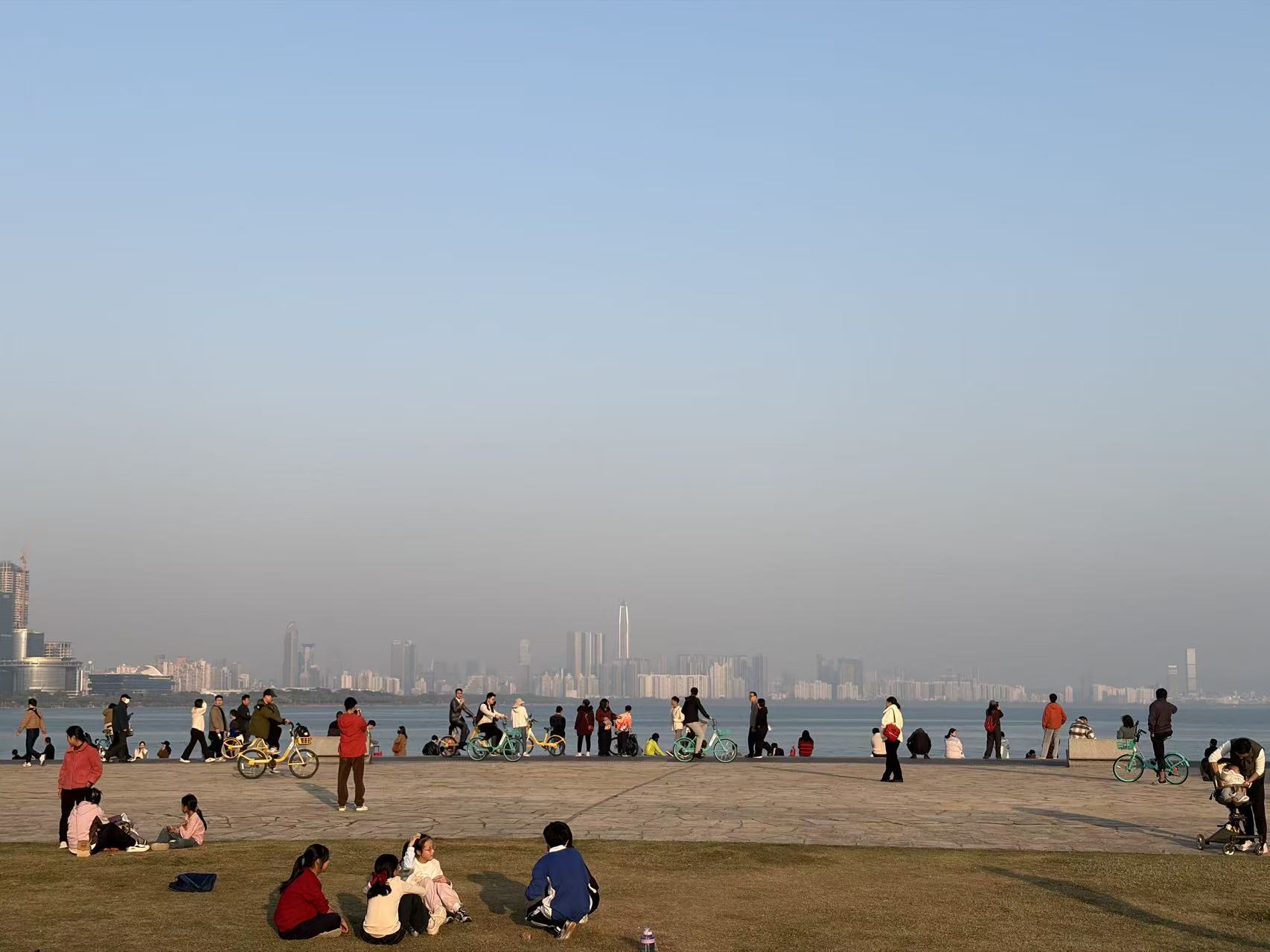
Sea breezes and urban walking routes. Historical photo from this site.
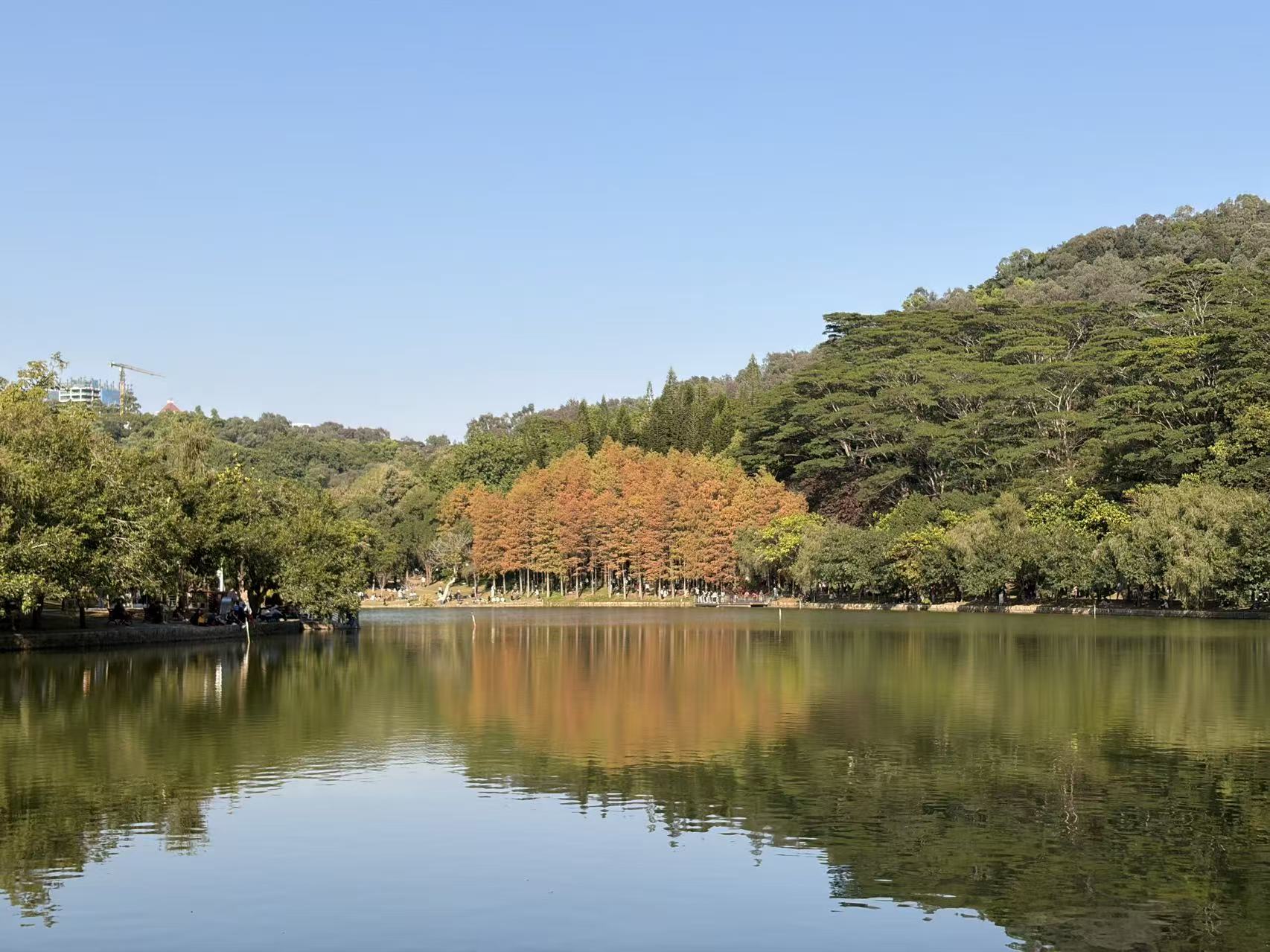
Greenery and shade in the central city. Historical photo from this site.
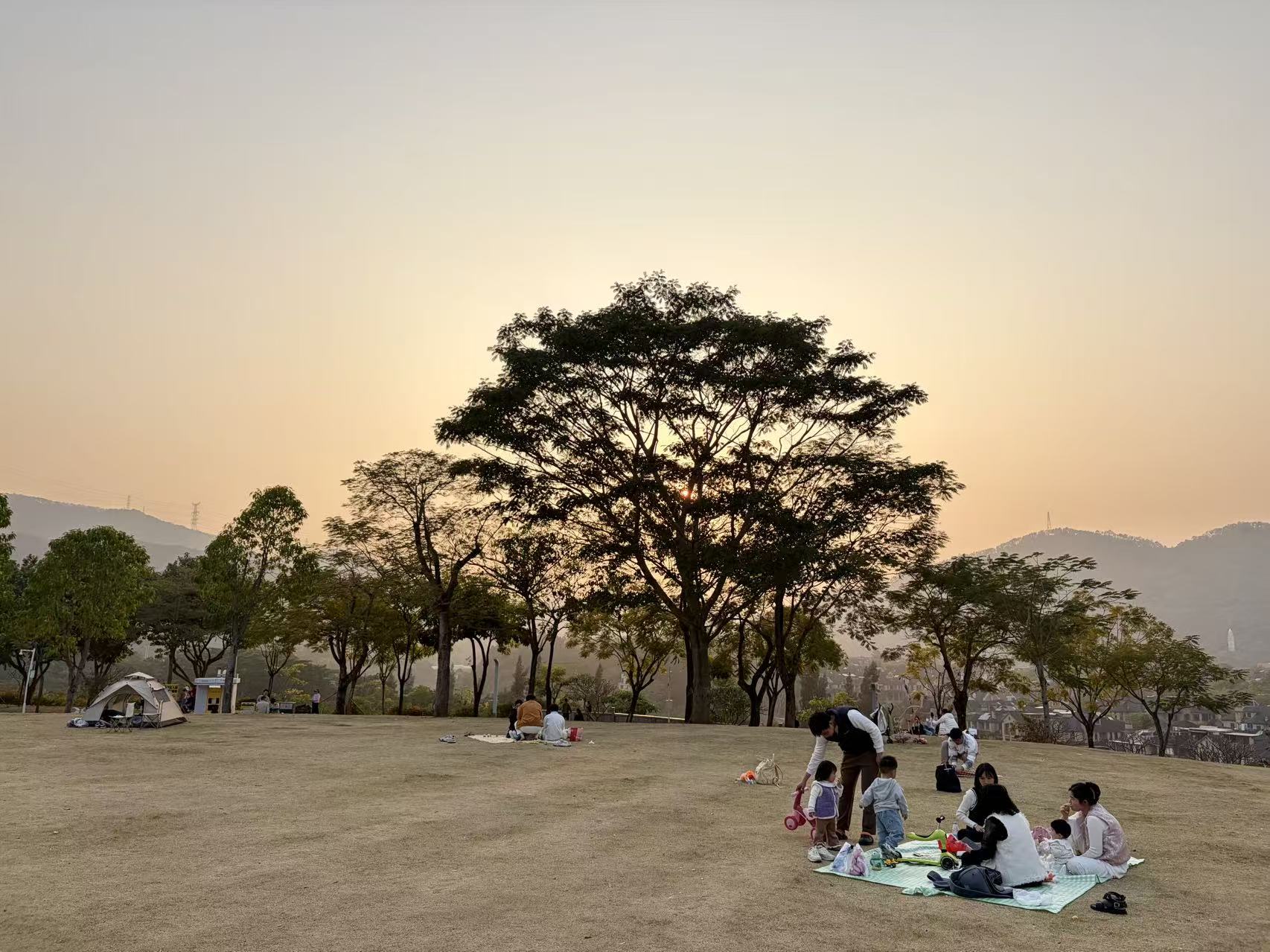
Watching the sunset close to home. Historical photo from this site.
References:Shenzhen Statistical Communiqué 2025;Annual Shenzhen Education Development Report;Introduction to Shenzhen's distinctive Cantonese dishes;Overview of Shenzhen's parks;Marriage registration statistics for 2025;Social Gender Statistical Report 2024;Urban Greening Statistics 2025. Statistical snapshots are not real-time values. Where different sources use inconsistent definitions, the original publication notes take precedence.
Figures for population, schools, patents, urban rail and parks in 2025 use the Shenzhen Statistics Bureau's annual communiqué. History, geography and local culture draw on public materials from the Shenzhen municipal government and the supplied encyclopedic sources. Images credit their photographers and original sources. Data from different periods, geographic boundaries or statistical definitions are not combined or extrapolated directly.
Added official figures for Shenzhen's GDP, high-tech manufacturing and retail sales in the first three quarters of 2026; preserved complete district-level annual data for 2025 and the verification status of 2026 district data without mixing reporting periods; restored compatibility for legacy URLs and standardized the navigation title as 'Shenzhen City Atlas.' Added nine topics: industry, education, food, parks, opening up, marriage and fertility, green space, GDP, and global supply chains, with official statistics, notes on definitions and site-hosted park photography.
This update improved desktop and mobile layouts, chart readability and keyboard navigation; repaired linked metric behavior in the 2025 scatter plot; expanded verification statuses, official sources and CSV export for district GDP in the first three quarters of 2026; and introduced sharing of the current chart view. Data remain fixed-period snapshots, not automatically gathered in real time. Unverified numbers are not estimated, and incompatible reporting periods are not mixed.